
There is no secret switch for how to rank in ChatGPT. To show up, an AI tool has to be able to find you, understand you, and trust that others agree you exist.
In practice that means four things. Let AI search crawlers in. Put clear facts on clear pages. Be in the indexes these tools draw on, including Bing. And collect reviews and mentions on other sites.
Most of that is ordinary SEO done properly. Google says so outright for AI Overviews. The rest of this guide separates what's confirmed from what's guesswork.
Why this matters now
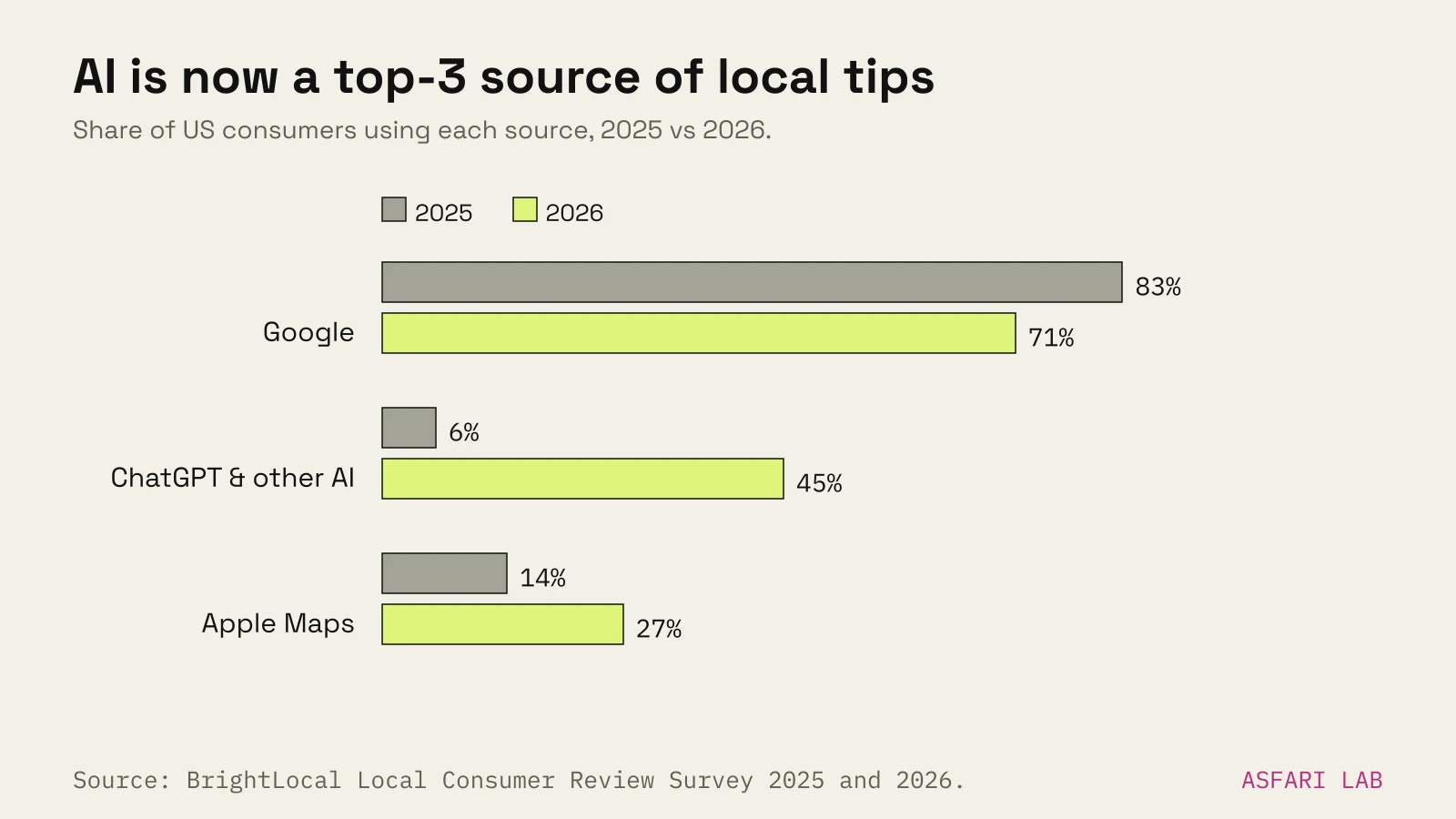
AI tools are now a real channel for local discovery. BrightLocal's 2026 consumer survey found 45% of US consumers used ChatGPT or similar AI tools for local recommendations, up from 6% a year earlier. That made AI tools the third most popular source in the survey.
Google's share fell over the same period, from 83% to 71%. And 82% now read AI-generated review summaries.
You don't need to panic about that. You need to make sure that when someone asks an AI "who does X near me", the answer has accurate facts about you to work with.
How to rank in ChatGPT: what's confirmed and what's guesswork
A lot of "generative engine optimization" (GEO) advice is confident and unproven. Here is where the evidence sits in October 2026.
| Claim | Status | Source |
|---|---|---|
| Blocking OAI-SearchBot keeps you out of ChatGPT search answers | Confirmed | OpenAI crawler docs |
| ChatGPT search can send queries to third-party providers such as Bing | Confirmed | OpenAI Help Center |
| ChatGPT tags referral links with utm_source=chatgpt.com | Confirmed | OpenAI publisher FAQ |
| AI Overviews need no special files, schema or optimisation | Confirmed | Google Search Central |
| Pages in AI Overviews must be indexed and eligible for a snippet | Confirmed | Google Search Central |
| llms.txt helps you get cited | Unproven. Google says it doesn't use it | Google statements, 2025 |
| Reviews and mentions on other sites raise your chances | Likely, not documented by OpenAI | Industry observation |
| Answer-first pages get quoted more | Likely, not documented | Industry observation |
| A specific "AI ranking factor" list | Speculative | None official |
Be wary of anyone selling guaranteed AI rankings. Nobody outside OpenAI or Google can promise that.
Step 1: let the right crawlers in
If a bot can't read your site, nothing else matters. Check your robots.txt (yoursite.com/robots.txt) and your hosting or CDN firewall.
| Crawler | Who | What it does | Allow it? |
|---|---|---|---|
| Googlebot | Search, including AI Overviews and AI Mode | Yes | |
| Bingbot | Microsoft | Bing search and Copilot | Yes |
| OAI-SearchBot | OpenAI | Shows sites in ChatGPT search answers | Yes, if you want to appear |
| ChatGPT-User | OpenAI | Fetches a page when a user asks | Usually yes |
| GPTBot | OpenAI | Collects content for model training | Your choice |
| Google-Extended | Controls use in some other Google AI training and grounding | Your choice |
OpenAI treats these bots separately. You can allow OAI-SearchBot to appear in search while blocking GPTBot from training. OpenAI says robots.txt changes take about 24 hours to apply in search.
Watch for firewall, CDN or security plugin settings that block "AI bots" in bulk. Check yours. On asfari.digital our robots.txt simply allows all crawlers and points to the sitemap.
If you're not even in Google yet, fix that first: why your website isn't showing on Google.
Step 2: be in the Bing index, not just Google
This step gets skipped most often. OpenAI's help page says ChatGPT search may pass queries to third-party search providers and names Bing as an example. Microsoft Copilot draws on Bing as well.
So:
- Verify your site in Bing Webmaster Tools. You can import it from Google Search Console in a few clicks.
- Submit your sitemap there.
- Set up IndexNow, so new and changed pages reach Bing within hours rather than weeks. Bing, Yandex, Naver, Seznam and Yep support it. Google doesn't.
- Claim your Bing Places listing for local searches.
We set up Search Console, a sitemap and IndexNow on asfari.digital in October 2026. It's one of the cheapest things on this list.
Step 3: make your facts easy to quote
AI answers are stitched together from short passages. Pages that state facts plainly are easier to use.
- Answer first. Open each service page with what you do, where, for whom and from what price. Put detail below.
- One topic per page. A page per service and per location beats one long "Services" page.
- Write facts as text. Hours, prices, areas served and contact details belong in HTML, not images or PDFs.
- Use the words customers use. "Wedding cakes in Tallinn" beats "bespoke celebration patisserie solutions".
- Add an FAQ with the real questions you get on the phone.
- Keep structured data honest. Organization or LocalBusiness schema in JSON-LD helps machines read your basics. Google says it must match what's visible on the page, and that no special AI schema exists.
- Date and update pages that carry prices or rules.
Our Pistache pâtisserie site, made in the lab, is a fair model. A clear one-line offer, phone-first layout, and one "Order for pickup" button.
Step 4: earn reviews, mentions and consistent listings
AI tools seem to lean on what other sites say about you, not just your own claims. OpenAI hasn't published how it weighs sources, so treat this as likely rather than proven. Either way, it's good business.
- Reviews. Recent, plentiful, with replies. See how to get more Google reviews.
- Listings. Google Business Profile, Apple Business, Bing Places, Facebook and one or two trade directories. Same name, address and phone everywhere. The full list is in our local SEO checklist.
- Mentions. Local press, partner pages, supplier "where to buy" lists, event pages, industry roundups. One genuine mention on a respected local site is worth more than dozens of directory submissions.
Google also recommends keeping your Business Profile up to date for AI features. That's the one local listing it names.
Do you need an llms.txt file?
Probably not, but it does no harm.
llms.txt is a proposal from Jeremy Howard, published in September 2024. It's a Markdown file at yoursite.com/llms.txt that lists your key pages with short descriptions. The spec itself calls it a proposal open for community input. It isn't a web standard.
Google has been clear. In June 2025 John Mueller said no AI system currently uses llms.txt. Around the same time, Gary Illyes said Google doesn't support it and isn't planning to. Google's AI features documentation says you don't need any new AI text files.
We have one on asfari.digital. It summarises our services and prices, and it's useful as a tidy fact sheet. But we don't claim it gets us cited. If someone sells you llms.txt as the main AI search fix, keep your wallet closed.
How to check if AI cites you
You can't see a full ranking report for ChatGPT. You can build a decent picture.
- Ask the tools. Once a month, ask ChatGPT (with search on), Gemini, Copilot and Perplexity the questions your customers ask. "Best bakery for wedding cakes in Tallinn." "Who installs heat pumps in Tartu?" Note who gets named, what facts are given, and which sources are linked.
- Check the facts. Wrong hours or old prices usually trace back to an outdated listing or page. Fix the source.
- Track referrals. In Google Analytics, look for traffic with utm_source=chatgpt.com. OpenAI adds it to ChatGPT referral links.
- Use Bing Webmaster Tools. Its AI Performance report, in public preview since February 2026, shows how often your pages are cited in Copilot and Bing AI answers, and the queries behind them.
- Read Search Console with care. Google counts AI Overviews and AI Mode traffic inside the normal Web report. You can't split it out, but rising impressions on question-style queries are a hint.
Write the results in a simple spreadsheet. Three months of notes tell you more than any "AI visibility score".