
For most small European shops, Shopify is the better choice. It is quicker to launch, harder to break and cheaper to keep running when nobody on your team wants to maintain a server.
WooCommerce wins when you need local payment methods without extra fees, full control of your data and hosting, or a shop that lives inside an existing WordPress site.
In Estonia and the Baltics, payment fees can decide it. Shopify charges an extra fee when you use bank links through a third-party provider. WooCommerce does not.
Below: Shopify vs WooCommerce pricing in euros, then payments, VAT, GDPR, hosting and languages, and a verdict by shop type.
The short comparison
| Shopify | WooCommerce | |
|---|---|---|
| What it is | Hosted shop platform, monthly plan | Free plugin for WordPress, self-hosted |
| Software cost | €24–€289/month billed yearly (Basic to Advanced) | €0 |
| Hosting | Included | You pay; WooCommerce quotes $25–$350/month (about €22–€313) |
| Extensions | Apps, often monthly | Plugins, $29–$299/year each (about €26–€267) |
| Card fees (own payments) | Shopify Payments, 1.5–2% + €0.25 for EEA standard cards | WooPayments, 1.5% + €0.25 for European cards (Estonian merchant) |
| Extra fee for other payment providers | 0.6–2% depending on plan | None |
| Updates and security | Shopify's job | Your job, or your developer's |
| Languages | Up to 20 on Basic to Advanced | Via a translation plugin |
| Checkout changes | Limited below Plus | Full control |
Shopify prices are from its euro pricing page. WooCommerce figures are from its own pricing page and fee documentation. Dollar amounts are converted at roughly €1 = $1.12 and are approximate.
Shopify vs WooCommerce pricing
WooCommerce is free software. Shopify is a subscription. That headline hides most of the real cost.
Shopify
Shopify Basic costs €24 a month billed yearly or €32 billed monthly. Grow is €69 or €92. Advanced is €289 or €384. EU merchants can be billed in euros.
Hosting, security, the checkout and updates are included. Most shops then add a few paid apps.
WooCommerce
The plugin costs nothing and takes no revenue share. You need hosting, a theme and usually some paid extensions.
A small Estonian host such as Zone lists WordPress plans from €9.95 to €30 a month on annual billing. Managed WooCommerce hosting costs more. WordPress.com's Commerce plan is $45 a month billed yearly (about €40).
Paid extensions add up. WooCommerce Subscriptions, for example, costs $279 a year (about €249).
The cost Shopify absorbs and WooCommerce does not: maintenance. WordPress core, the theme and every plugin need updates and backups. Someone has to do it, and test that checkout still works afterwards.
Our online shop cost guide runs a full one-year comparison for a small EU shop.
Payments: Stripe, Klarna and Estonian bank links
This is where the European angle matters most.
Cards
Both platforms offer their own card processing, and both are available in Estonia and most of the EU.
- Shopify Payments, Basic plan: 2% + €0.25 for EEA standard cards, 3.1% + €0.25 for international and Amex cards.
- WooPayments, Estonian merchant: 1.5% + €0.25 for European cards. Non-European cards add 2%.
- Stripe direct (works with WooCommerce): 1.5% + €0.25 for standard EEA cards, 2.8% + €0.25 for premium EEA cards.
Klarna
Klarna through Shopify Payments costs 4.99% + €0.35 on Basic to Advanced. Through Stripe it starts at 2.99% + €0.35.
Bank links
In Estonia, many shoppers expect to pay through their own bank: Swedbank, SEB, LHV and others. Providers such as Montonio bundle these bank links with cards and pay-later.
Here the platforms split.
On WooCommerce, Montonio's Starter plan is €11.99 a month with bank payments at €0.20 each. Its Core plan is €14.99 a month with bank payments at €0.05.
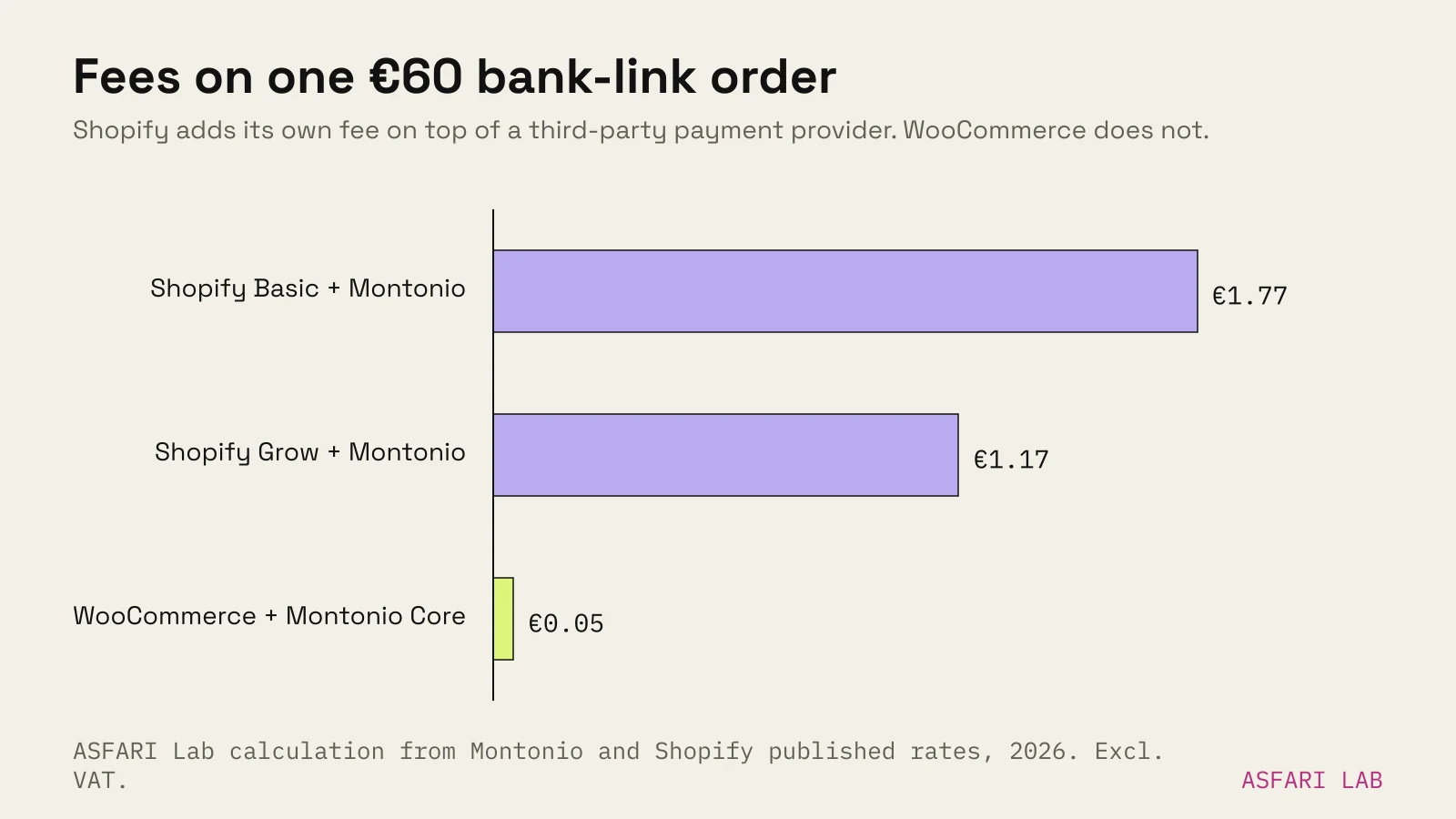
On Shopify, Montonio has separate pricing: €14.99 a month, bank payments at 0.79% + €0.10. Shopify then adds its own third-party fee: 2% on Basic, 1% on Grow. Shopify confirms this fee applies even when Shopify Payments is also switched on.
A worked example. A €60 order paid by bank link:
| Setup | Provider fee | Shopify fee | Total per order |
|---|---|---|---|
| WooCommerce + Montonio Core | €0.05 | — | €0.05 |
| Shopify Basic + Montonio | €0.57 | €1.20 | €1.77 |
| Shopify Grow + Montonio | €0.57 | €0.60 | €1.17 |
Calculated from Montonio's and Shopify's published rates, excl. VAT.
At 500 bank-link orders a year, that gap is roughly €860 on Basic. It is real money, but not always decisive. Weigh it against what you would spend maintaining WordPress.
VAT, OSS and selling across the EU
Both platforms can handle EU VAT. Neither files it for you.
The rule: once your cross-border sales to EU consumers pass €10,000 a year in total, you charge VAT at each customer's country rate. The One-Stop Shop lets you declare and pay all of it through one quarterly return in your home country.
What that means for your shop:
- Shopify lists VAT validation and invoicing among its features, and duty and tax estimates on every plan. Selling in several markets is built in through Shopify Markets.
- WooCommerce has tax tables in the core plugin. Most EU shops add an extension for country rates, VAT number checks and compliant invoices.
On either platform, set prices to include VAT for consumers. Showing a lower price and adding VAT at checkout is a common reason people leave, as we cover in why shoppers abandon carts.
GDPR, hosting and data
Shopify is hosted for you. European merchants contract with Shopify International Limited, a company in Ireland. Shopify publishes a data processing addendum. You cannot choose where your servers are.
WooCommerce runs wherever you host it. You can keep data on an EU server with an EU company. You also own the security. A hacked plugin is your incident to report.
For most small shops, either is workable under GDPR. Cookie consent, a privacy policy and sensible apps matter more than the platform.
Languages and markets
Shopify lets you sell in up to 20 languages on Basic to Advanced, and 30 on Plus. Its Translate & Adapt app handles manual or AI translation. Prices in local currencies need Shopify Payments.
WooCommerce needs a multilingual plugin. These work well but add cost, setup and another thing to update.
For a shop selling in Estonian, English and Finnish or Russian, both cope. Shopify is quicker to set up.
Shopify vs WooCommerce: which is better for your shop?
There is no single winner. Here is our verdict by shop type.
| Your shop | Our pick | Why |
|---|---|---|
| New brand, under 200 products, no developer | Shopify | Fastest to launch, least to maintain |
| Estonian shop where most customers pay by bank link | WooCommerce, or Shopify Grow if you value low maintenance | Bank-link fees are far lower on WooCommerce |
| Already have a busy WordPress site and blog | WooCommerce | One system, content and shop together |
| Selling across many EU countries and currencies | Shopify | Markets, languages and currencies built in |
| Unusual rules: trade pricing, complex options | WooCommerce or custom | Full code access |
| Wants a highly customised checkout | WooCommerce, or Shopify Plus | Shopify limits checkout changes below Plus |
When the shop logic is truly unusual, neither may be enough. Our post on Shopify or a custom shop covers when custom code earns its cost.
We build on both. The two shop concepts we made in the lab, Oak & Form (furniture, shop by room, swatches) and Audiokind (audio, product comparison table), show the kind of product pages either platform can carry with good design.