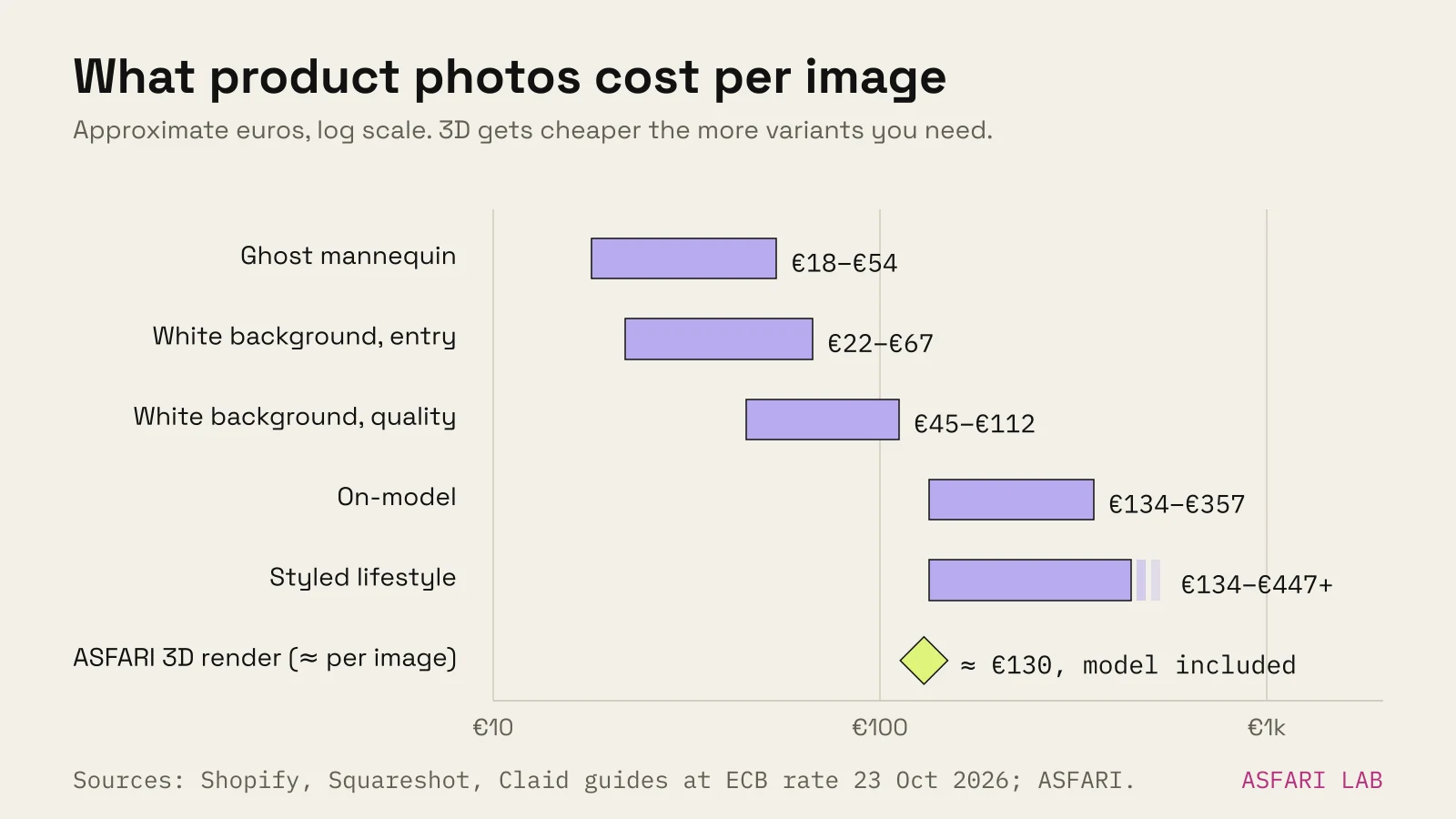
Product photography costs roughly €22–112 per image for clean white-background shots and €134–447 or more for lifestyle or on-model images, based on 2026 price guides. A photographer's day rate runs from about €447 to €2,680 before crew and props.
For one product in one colour, a shoot is usually the cheaper option.
3D renders start to win when you have many colourways, products that don't exist yet, or images you need to update each season. Below are the numbers, and a simple way to find your break-even point.
Product photography cost per image: the 2026 ranges
Most price guides are in US dollars. We converted them at the European Central Bank reference rate of 23 October 2026 ($1.1193 per €1) and rounded. The euro figures are approximate. Local studio rates in your country may sit higher or lower.
| Type of image | Market range (USD) | Approx. in € | Source |
|---|---|---|---|
| White background, entry level | $25–75 | €22–67 | Squareshot; Claid (2026) |
| White background, quality e-commerce | $50–125 | €45–112 | Squareshot (2026) |
| Ghost mannequin (clothing) | $20–60 | €18–54 | Claid (2026) |
| Flat lay with props, add-on | +$30–75 | +€27–67 | Squareshot (2026) |
| Styled lifestyle | $150–500+ | €134–447+ | Claid (2026) |
| On-model (apparel, footwear) | $150–400 | €134–357 | Squareshot (2026) |
| Any product image, broad range | $50–350 | €45–313 | Shopify (2026) |
Day rates and extras
Shopify's 2026 guide puts a product photographer at $500–3,000 per day (about €447–2,680). It adds that final numbers can be much higher once assistants and equipment are counted. Claid lists $1,500–5,000+ (about €1,340–4,470) for commercial studio or location days.
Then come the extras: - Models: fees vary widely with experience and agency. - Stylists: food stylists alone can be a few hundred to $2,000 a day, per Shopify. - Rush: Shopify cites rush fees of 25% to 200% of the job. - Retouching: often priced per image; check if it is included. - Samples: every colour must exist physically, and be shipped to the studio.
What pushes the price up
- Reflective and clear products. Glass, chrome and jewellery need careful light and more retouching.
- Many angles per product. Six angles cost close to six images.
- Consistency across a big range. Matching light and shadow across 200 products takes discipline and time.
- Location shoots. Travel, permits and weather.
- People. Models, hair and make-up, and usage rights for the images.
Product photography pricing guide: what to ask before you book
Ask the same questions of every studio:
- Is the price per image, per product, or per day?
- How many angles per product are included?
- Is retouching included, and how many rounds?
- What are the image rights? Can you use the images in paid ads and on marketplaces?
- What file sizes and crops do you get (square for Amazon, 4:5 for social and so on)?
- Who pays to ship samples, and back?
A cheap per-image price with paid retouching and limited usage rights can end up costing more than a higher flat price.
Per image, per product or per day?
Each model suits a different shop.
- Per image is easiest to budget for small ranges. You know the total before the shoot.
- Per product (per SKU) bundles a set number of angles. Claid lists $15–300 per product (about €13–268), depending on location, complexity and angles. Check exactly which angles are in.
- Per day suits big batches of similar products. A fast studio can shoot many white-background products in a day. A styled lifestyle set might give only a handful of finished images.
Volume discounts are common. Squareshot's own sample tiers start at $100 per image for the first 1–25 images and drop from there. If you plan to add products every month, ask for a rate card, not a one-off quote.
The hidden cost: time
A shoot needs finished samples in every colour, shipped and returned. If your production is late, so are your images. For a launch, that can mean a product page with placeholder images on day one. With 3D, images can be ready before the first unit ships.
When 3D is cheaper than a photo shoot
3D has a different cost shape. You pay up front to build the model. After that, each extra image, colour or scene costs much less.
So the question is not "which is cheaper per image?" It is "how many images will I need from this product, over its life?"
A worked example: one product, ten colours, three angles
That is 30 images.
- Photography: at Shopify's $50–350 per image, 30 images cost about $1,500–10,500 (roughly €1,340–9,380). You also need all ten colours made as finished samples.
- 3D: Frame Sixty, a US studio, prices exactly this kind of job (one product, ten colourways, three angles) at $1,200–3,500 per product family. That is roughly €1,070–3,130. No samples needed beyond one for reference.
At the low end the costs are close. As quality and colour count go up, 3D pulls ahead. Our earlier post on 3D product animation vs photography runs a larger version of this, with 48 images.
The break-even rule of thumb
This is our estimate, not a published formula. 3D tends to come out cheaper when two or more of these are true:
- you have five or more colours or finishes per product;
- the product isn't manufactured yet, so there is nothing to photograph;
- you reshoot every season for new backgrounds or campaigns;
- you need exploded or cut-away views, which a camera can't take;
- you'll also want a 360 spin, animation or 3D viewer, which reuse the same model;
- the product is glass, chrome or liquid, where a photo shoot needs heavy retouching anyway.
Where photography still wins
- One product, one colour, a few angles.
- Food, fabric drape and anything that needs a real person.
- Products where texture is the whole sale and very hard to model: knitwear, natural wood with heavy grain, artisan ceramics.
- When you need images this week and have the product on your desk.
Many shops do both, and our 3D product renders are made to sit next to photos. Photograph the hero lifestyle shots with people. Render the variants, the white backgrounds and the exploded views. See how much 3D product rendering costs for the 3D side in detail.
Ecommerce product photography services vs 3D: side by side
| Photography | 3D renders | |
|---|---|---|
| Needs a physical sample | Yes, of every colour | One for reference, or CAD files |
| Cost of the first image | Lower | Higher (the model) |
| Cost of each extra colour | Similar to the first | Much lower |
| New scene next season | New shoot | Re-render with the same model |
| Exploded or inside views | Hard or impossible | Standard |
| Real people, food, fabric drape | Best | Hard |
| Turns into a 3D viewer or AR | No | Yes, from the same model |
Amazon is a special case. Its main image rules are strict about showing the actual product. We cover that in 3D renders for Amazon and Shopify. And whatever you choose, how you use the images on the page matters as much; see product page examples.