The most useful questions to ask when hiring a web designer are not about style. They are about scope, price, who owns what, when it ships and what happens after launch.
Portfolios show taste. Answers show how a project will actually run.
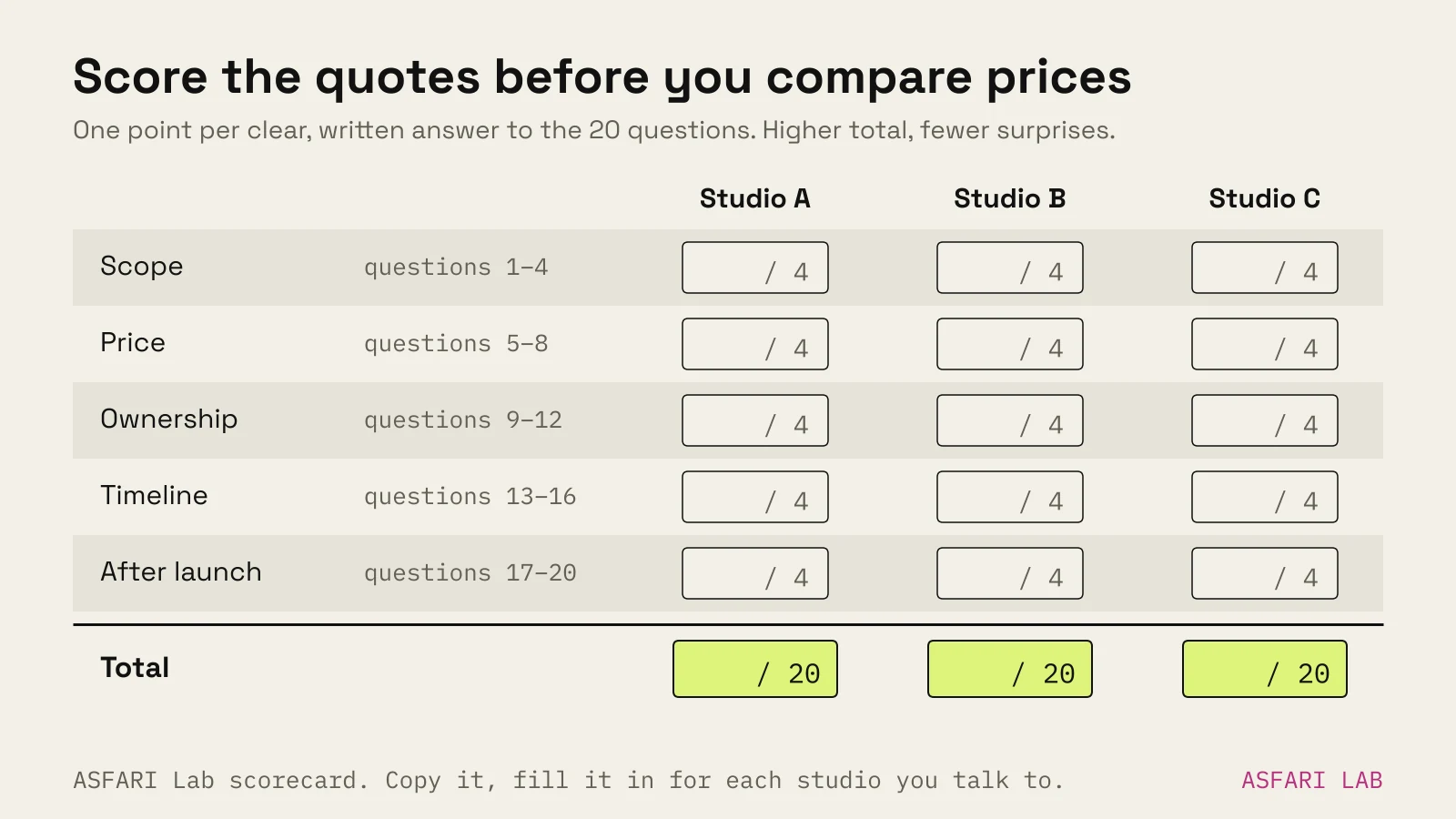
Below are 20 questions in five groups. For each, we say what a good answer sounds like. At the end there's a list of red flags. Use it on every studio and freelancer you talk to, including us.
Before you ask: have a brief ready
You'll get far better answers if you send a short brief first. One or two pages: goal, audience, pages, must-have features, budget range, deadline, who decides.
We wrote a template for it: how to brief a creative web agency. With a brief in hand, every designer is quoting for the same job, and you can compare answers fairly.
Scope: what exactly are you building?
1. What's included in the price, page by page? Good answer: a list of pages or templates, features (forms, booking, shop, languages) and what's out of scope. "A five-page site" is not a scope.
2. Who writes the text and supplies the photos? Good answer: a clear split. If they write copy or source photos, it's priced. If you do, they tell you when they need it and in what form. Missing content is the most common reason projects stall.
3. What platform will you build it on, and why that one? Good answer: a reason tied to your needs, such as who will edit it, budget, speed or features. Our comparison of Webflow, Framer and custom code explains the trade-offs.
4. How will the site help me get found on Google? Good answer: specifics. Page titles and descriptions, a sitemap, Search Console set up, fast mobile pages, structured data where it fits. Google's own advice on hiring SEO help is a good benchmark: ask how results are measured and expect every change to be explained.
Price: what will it really cost?
5. Is this a fixed price or an estimate? Good answer: fixed for a defined scope, with a written rule for changes. "Depends" with no range is not an answer.
6. How many rounds of revisions are included? Good answer: a number, written into the scope. Our Launch package, for example, includes two rounds of design feedback. Know what an extra round costs before you need it.
7. What are the running costs after launch? Good answer: domain, hosting, platform subscription, plugins, email and maintenance, each with a yearly figure. Our post on website maintenance cost lists what's normal.
8. What's the payment schedule? Good answer: staged payments tied to milestones, for example a deposit, then design sign-off, then launch. Be wary of 100% upfront on a large project.
Ownership: what will I own when we're done?
9. Whose name will the domain be registered in? Good answer: yours, or your company's, from day one. The registrant is the legal holder. If it's in the designer's name, moving later can be slow.
10. Whose account will hosting and the platform be on? Good answer: yours, with the designer added as a user. You pay the provider directly or are billed transparently.
11. Do I own the design and code after final payment? Good answer: yes, in writing, with any exceptions named (licensed fonts, stock photos, their reusable components). Our guide who owns your website covers what to put in the contract.
12. Can I move the site to another developer or host later? Good answer: an honest one. Some builders don't allow it. Wix, for example, says sites must be hosted on Wix's servers. That can be fine, but you should know before you start.
Timeline: when will it be live?
13. How long will it take, and what's the plan week by week? Good answer: phases with dates. Discovery, design, build, content, testing, launch. Our post on how long it takes to build a website gives realistic ranges.
14. What do you need from me, and by when? Good answer: a list of inputs and deadlines. Delays on the client side are normal. A good designer plans for them.
15. Who will I actually work with? Good answer: names. Who designs, who builds, who answers your emails. Know whether any work is subcontracted.
16. How will we test before launch? Good answer: real phones and browsers, form tests, speed checks with PageSpeed Insights, broken-link checks, and a staging link for you to review.
After launch: who looks after it?
17. What happens in the first 30 days after launch? Good answer: a fix period for bugs, plus checks that Google is indexing the site and that forms and tracking work.
18. How do I make small edits myself? Good answer: a short handover. A recorded walkthrough or written guide for changing text, images and prices.
19. Who handles updates, backups and security? Good answer: named responsibility. Either you, with clear instructions, or them, on a priced plan.
20. How will we know if the site is working? Good answer: agreed measures from day one. Enquiries, bookings, calls or sales, tracked in analytics, reviewed after launch.
Questions to ask when hiring a web designer: the red flags
Some answers should end the conversation or at least slow it down.
| Red flag | Why it matters |
|---|---|
| "We'll register the domain for you" (in their name) | You don't legally hold your own address |
| No written scope, just a total price | Every extra becomes a dispute |
| Guaranteed number-one ranking on Google | Google says no one can guarantee a top ranking |
| Can't show a live site they built | Mock-ups prove less than working sites |
| No mention of hosting or running costs | The bill arrives after launch |
| Refuses to put ownership in the contract | You may not be able to leave |
| 100% payment before any design | Little reason to finish well |
| Asks for full access to everything during a quote | Read-only access is enough at that stage |
| No answer to "who will I work with?" | You may be buying a hand-off |
| Pushes a long contract with high exit fees | Lock-in rather than service |
The Google warning is worth knowing in its own words. Its guide for site owners hiring SEO help says "No one can guarantee a #1 ranking on Google." It also advises giving only read access to Search Console during an audit.
How to choose a web design agency from the answers
Once you have answers from two or three studios, compare them side by side.
- Line up the scopes. Same pages, same features? If not, ask the cheaper one what's missing.
- Add the running costs. A cheap build on an expensive platform can cost more over three years.
- Check ownership. Domain, hosting, design files and code, all in your name or clearly licensed.
- Trust specifics. The agency that answers with dates, names and numbers is usually the one that delivers.
- Pick the one you can talk to. You'll exchange dozens of messages. Clarity now predicts clarity later.
For price benchmarks, read how much a small business website costs.
How we'd answer
We'd rather show than claim. On our Websites & apps page, packages list what's included: Launch has up to five pages and two rounds of design feedback. Growth adds 30 days of post-launch optimisation, Scale 90 days. Prices are starting prices excl. VAT, and the final scope and price are agreed before we start.
On ownership the page is short: "Your files, your accounts."