How long does it take to build a website? Our estimate for a five-page small business website, built by a studio or a good freelancer: four to eight weeks. That assumes your text and photos are ready, or nearly.
An AI builder can make a draft in minutes. You can publish a simple builder site in a day. A custom site built from scratch takes months.
The build itself is rarely the slow part. Content and decisions are. Most websites that launch late were waiting for words, photos or a yes.
Below: how long it takes to build a website by route, what really causes delays, and a week-by-week example you can plan around.
How long does it take to build a website? By route
| Route | Time to a live site | What decides the date |
|---|---|---|
| AI builder | Minutes for a draft; a few days to make it yours (estimate) | Replacing generic text and photos |
| DIY builder (Wix, Squarespace) | A day for a simple site; days to weeks with forms or a shop | Your free evenings |
| Freelancer | A few weeks | Their queue and your content |
| Studio | 4–8 weeks for up to 5 pages (our estimate) | Content and feedback rounds |
| Custom, from scratch | Several months | Features, integrations, testing |
Where the numbers come from: Wix says its AI builder creates a business-ready site "within minutes". GoDaddy's guide puts a simple builder site at a few hours to a day, and several pages with forms or ecommerce at a few days to a few weeks. It gives a few weeks for a simple site with a web designer and several months for a large custom one.
The studio row is our own estimate. It is based on the four steps our projects follow, with two rounds of design feedback.
With AI
The AI part really is fast. Wix's builder asks you questions in a chat, then generates a layout, theme, text and images.
What takes time is everything after. The text is generic. The photos are stock. Your prices, hours and address need checking line by line. Plan a weekend, not ten minutes.
On Wix or another builder
A one-page site with your hours and a contact form: a day. Five pages with real copy, a booking tool and your own domain: two to three weeks of evenings (our estimate).
The tool is quick. Learning it, choosing a template and writing every page is not. If you're unsure which route suits you, read website builder vs web designer.
With a freelancer
Usually a few weeks once they start. The catch is the start date. Good freelancers are booked ahead, and one person can only run so many projects at once.
With a studio
Four to eight weeks for a small site is typical (our estimate). A studio can run design and build in parallel, so the timeline depends more on you than on them.
From scratch
Custom code, custom features and integrations take months. GoDaddy's guide says the development stage alone takes at least a couple of months for a site built from scratch. That's right for an app or a complex shop. It's overkill for a five-page business site.
What actually causes delays
Almost every late website is late for one of these reasons.
- Content. Owners often underestimate how long writing takes. Speckyboy's piece on stalled projects names client-created content as a classic blocker, because it tends to come last.
- Too many deciders. Three people with different opinions and no final say. Every round of feedback becomes a debate.
- No time on your side. You run a business. A feedback email that takes two weeks adds two weeks.
- New features mid-project. "Can we add booking?" Booking, pre-orders and integrations change scope. They are things to decide before the start, not in week four.
- Lost logins. The domain is in an old employee's name. Nobody knows the hosting password. This one can cost a week on its own.
- Google. Launch is not the finish line. Google says crawling can take anywhere from a few days to a few weeks. Your site may not show in search on launch day.
Notice that the build itself isn't on the list. Design and code are the parts a decent team can schedule.
A week-by-week example timeline
Here is what a six-week, five-page project can look like. It's an example, not a promise. Your scope and content decide the real dates.
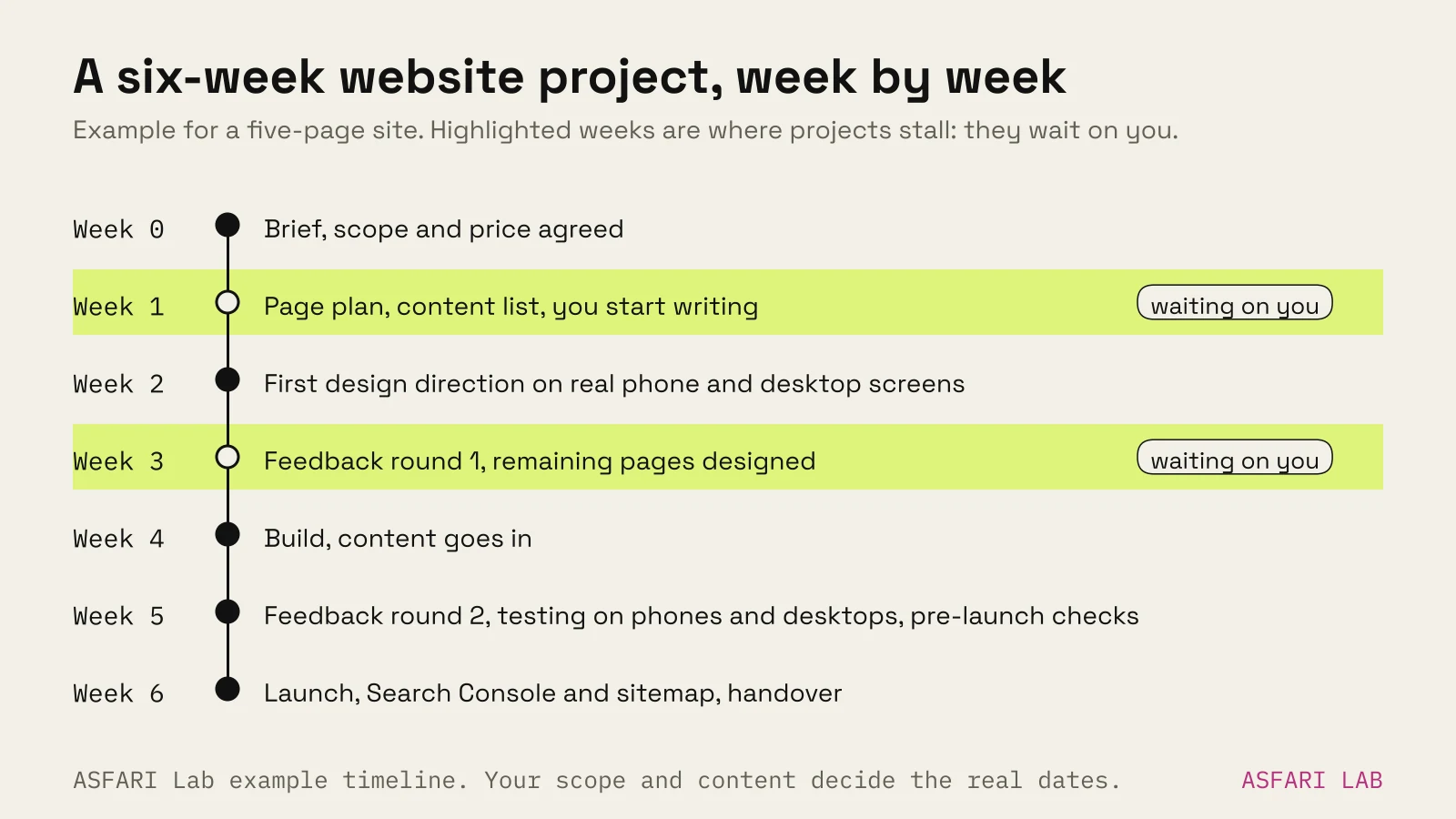
Week 0: brief. You tell us what you sell, to whom, and what a visitor should do. Scope and price are agreed before anything starts.
Week 1: plan and content. We agree the pages and what goes on each. You start writing, or we write from your notes. Photos get booked or chosen.
Week 2: first design. One direction, shown on real phone and desktop screens. Not a mood board. A page you can scroll.
Week 3: feedback, round one. You send one batch of comments. The other pages get designed in the same style.
Week 4: build. The design becomes a working site. Real content goes in. Forms, maps and tracking get connected.
Week 5: feedback and testing. Round two of feedback. Testing on phones and desktops. A pre-launch check of speed, legal pages and links. Our small business website checklist covers what to look for.
Week 6: launch. The domain points to the new site. Search Console, sitemap and analytics go live. You get your files and accounts.
Weeks 1 and 3 are where projects slip. Both depend on you.
How to get your website built faster
- Write first. Have rough text for every page before the designer starts. Rough is fine. Missing is not.
- Pick one decider. Others can comment. One person says yes.
- Find your logins now. Domain registrar, current host, Google account, social accounts.
- Decide features up front. Booking, pre-orders, payments, a second language. Each one changes the plan and the cost of a small business website.
- Batch your feedback. One list per round, within two working days.
- Launch small. Five good pages beat twelve half-written ones. Add the rest after launch.
When fast is the wrong goal
A week is possible for a one-page site with content ready. It's rarely worth forcing for anything bigger.
Rushed sites tend to skip the boring parts. The privacy policy. The cookie banner. Testing the contact form on a real phone. Those are the parts that cost you later.
If you have a hard date, such as an opening or a launch event, tell your designer at the start. Work back from it. Cut pages, not checks.