
For an ad with one offer, send people to a landing page. One message, one button, nothing else to click. For everything else, including search, trust and repeat customers, you need a website.
So in the landing page vs website choice, most businesses running ads end up with both. The website is home. Landing pages are the doors you build for each campaign.
If you only have budget for one, it depends what you sell. Here's how to decide.
The landing page vs website difference
A landing page is built for one visitor arriving from one place, to do one thing. A website is built for everyone, to do many things.
| Landing page | Website | |
|---|---|---|
| Purpose | One action: order, book, sign up | Inform, reassure, be found, take several actions |
| Traffic | Mostly ads, email, a QR code | Search, social, word of mouth, ads |
| Navigation | None, or anchor links on the same page | Menu with several pages |
| Pages | One | Usually 5–12 for a small business |
| Lifespan | Weeks or months, per campaign | Years |
| Shows up on Google organically | Rarely | Yes, if built for it |
| Measuring results | Easy: one button, one number | Harder: many paths |
The core idea: every link on a page is a way out. A landing page removes the exits that don't lead to the one action you want.
Landing page or website for Google Ads?
Google doesn't require a landing page. It does judge whatever page your ad sends people to.
Landing page experience is one of the parts of Quality Score. Google describes it as how relevant and useful your page is to people who click your ad. It rates it against other advertisers for the same searches over 90 days.
Google's own guidance for those pages is plain:
- Match the page to the ad and keyword. If the ad promises a discount, show the discount.
- Reflect the ad's call to action. If the ad says "order for pickup", the button should say that too.
- Put the key information near the top.
- Keep it quick and simple on phones.
- Avoid clutter and pop-ups.
And Google states that higher ad quality "generally leads to better performance, including better ad positions and lower cost".
There's also a hard line. Pages with no original content, pure redirects or empty placeholders break Google's destination policy, and the ad gets disapproved. A landing page still has to be a real page.
Which page to use
- One product, one offer: a landing page.
- Branded search (people typing your name): your home page.
- Broad service searches ("plumber Tallinn"): a service page on your website, or a landing page that does the same job.
- Many products: the matching category or product page, not your home page.
When a single page is enough
A one-page site works when the decision is simple and the customer already wants the thing.
Typical cases:
- A seasonal offer or event
- One flagship product
- A pre-order or waiting list
- A café, pop-up or stall that mainly needs "what, where, when, order"
- An app download
- A lead magnet: a guide, a free check, a quote request
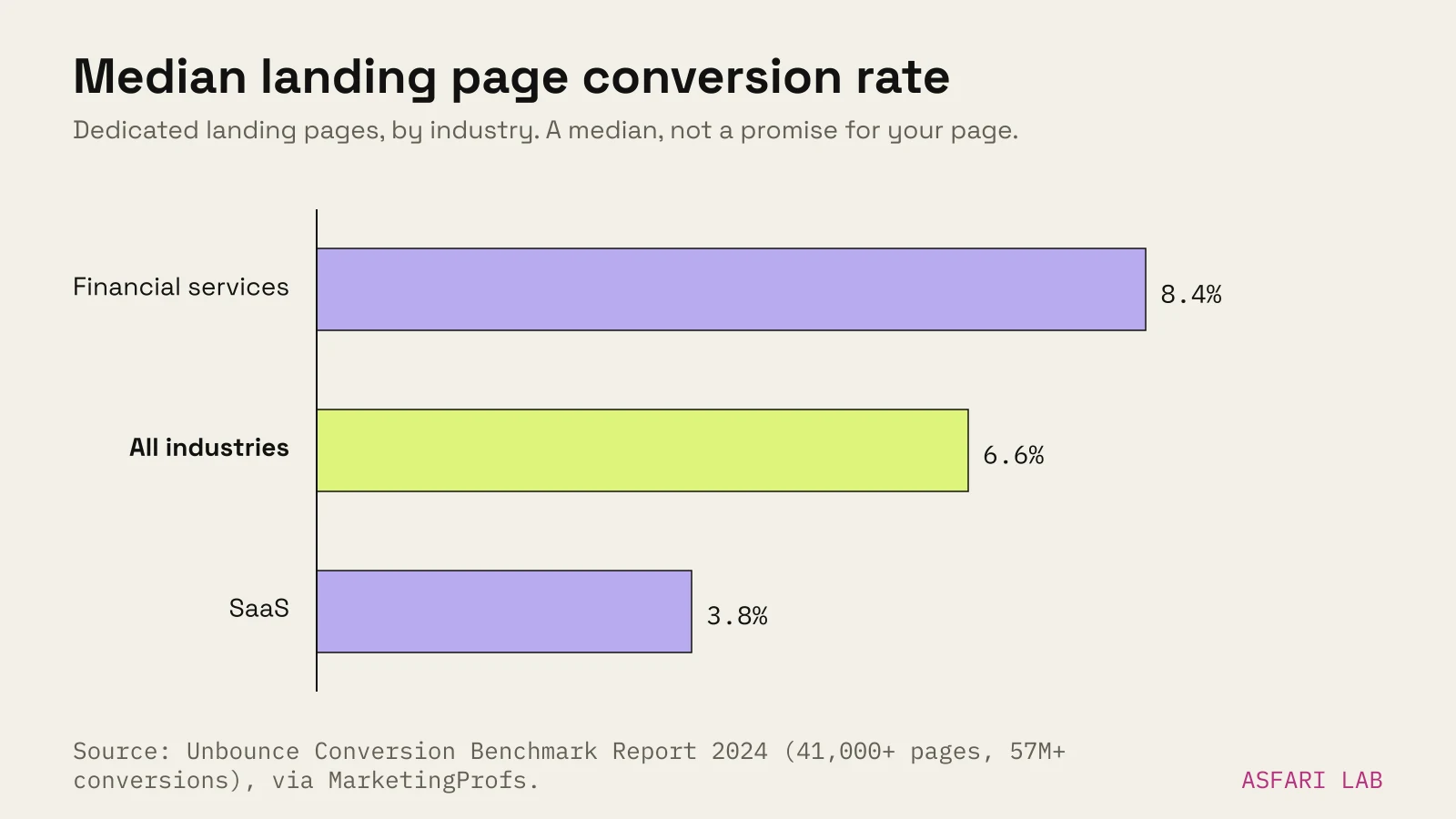
Single pages convert well when they're focused. In Unbounce's 2024 benchmark of more than 41,000 landing pages, the median conversion rate across industries was 6.6%. That's a median for dedicated landing pages, not a promise for yours.
A one-page website example: Pistache
In the lab we made Pistache, a pâtisserie and gelato site set in Telliskivi, Tallinn. It's a single page, built for one job.
What it does:
- One line of offer at the top: what it is and where.
- One button, "Order for pickup", repeated in the header, the hero and the closing section. Same words every time.
- The menu, twelve items with prices, shown as a gallery you can spin or lay out as a grid.
- "Our day": three short facts that build trust.
- Visit: address, opening hours, a note about 48-hour pre-orders for cakes.
There are no separate About, Blog or Careers pages. The navigation only jumps down the same page.
It's designed phone-first, because that's how someone scrolling past an ad would see it. If you ran a "pistachio éclair, order for pickup" ad, this is the kind of page you'd send it to.
What it can't do well: rank for many different searches, explain a catering service, or recruit staff. That's when you add pages, or a full site.
When you need a full website
You need more than a landing page when:
- People research before buying. Services, B2B, anything expensive.
- You sell several different things to different people.
- You want organic search traffic. Separate pages for separate topics rank better than one long page.
- Trust takes proof. Case studies, team, certifications, policies.
- You run several campaigns at once. Each needs its own page, and they need a home to link back to.
A landing page with nowhere to go is fragile. Many visitors won't act on the first visit. They'll come back by searching your name, and they should find a proper site. If you rely on Instagram alone for that, read Do you need a website if you have Instagram?
Landing page cost
Prices vary as much as for websites. Here's a realistic picture in euros, excl. VAT.
| Route | Cost | Notes |
|---|---|---|
| DIY on your builder | €0 extra | If you already pay for Wix or Squarespace |
| Freelancer | about €360–€900 | One to two days at €290–€449 a day (Malt France averages) |
| Inside a website package | included | ASFARI Growth (from €1,900) includes landing pages built for A/B testing |
| Standalone one-page site | from €900 | Our Launch package covers up to five pages, so a single page fits comfortably |
The freelancer figure is our estimate: a typical one-page build of one to two days, multiplied by Malt's published average day rates. It's not a quoted market price.
Running costs are the same as any small site: domain, hosting, maybe a form tool. See How much does a small business website cost in Europe? for the full breakdown.
How to build a landing page that works
Seven rules, in order of importance.
- One goal. Decide the single action before you write anything.
- Match the ad. Same offer, same words, same image if possible.
- Say it in one line. What it is, for whom, why now.
- One button, repeated. Same label every time it appears.
- Answer the three objections. Usually price, timing and trust.
- Build for the phone first. Google's own advice notes many ad visitors arrive on phones.
- Track one number. Orders, bookings or leads, not page views.
If you're already getting clicks but no sales, the page is often the problem, not the ads. We cover that in Website traffic but no sales.