Yes, if you want people who don't follow you yet to find you, trust you and book. Instagram is where people discover you. A website is where they check you're real and act.
The website vs Instagram for business question has a plain answer. Keep both, but own one. Your Instagram account belongs to Meta, and it can be switched off overnight.
The good news: the website doesn't need to be big. Here's why it matters, what each channel does well, and the smallest version that works.
Website vs Instagram for business: the short answer
Instagram is good at:
- Showing your work, every week
- Reaching people who don't know you yet, through Reels and hashtags
- Staying in touch with regulars
A website is good at:
- Showing up when someone searches Google for what you sell
- Answering practical questions: prices, hours, address, how to book
- Taking bookings, orders and enquiries
- Proving you're an established business
You need Instagram if your customers are there. You need a website if you want them to act.
What happens after someone reads your reviews
BrightLocal surveys US consumers about local businesses every year. In its 2026 survey of 1,002 adults, 97% read reviews for local businesses.
Then the interesting part. After reading positive reviews:
- 54% go to the business's website
- 37% read more reviews
- 31% visit the location
- 24% check its social media
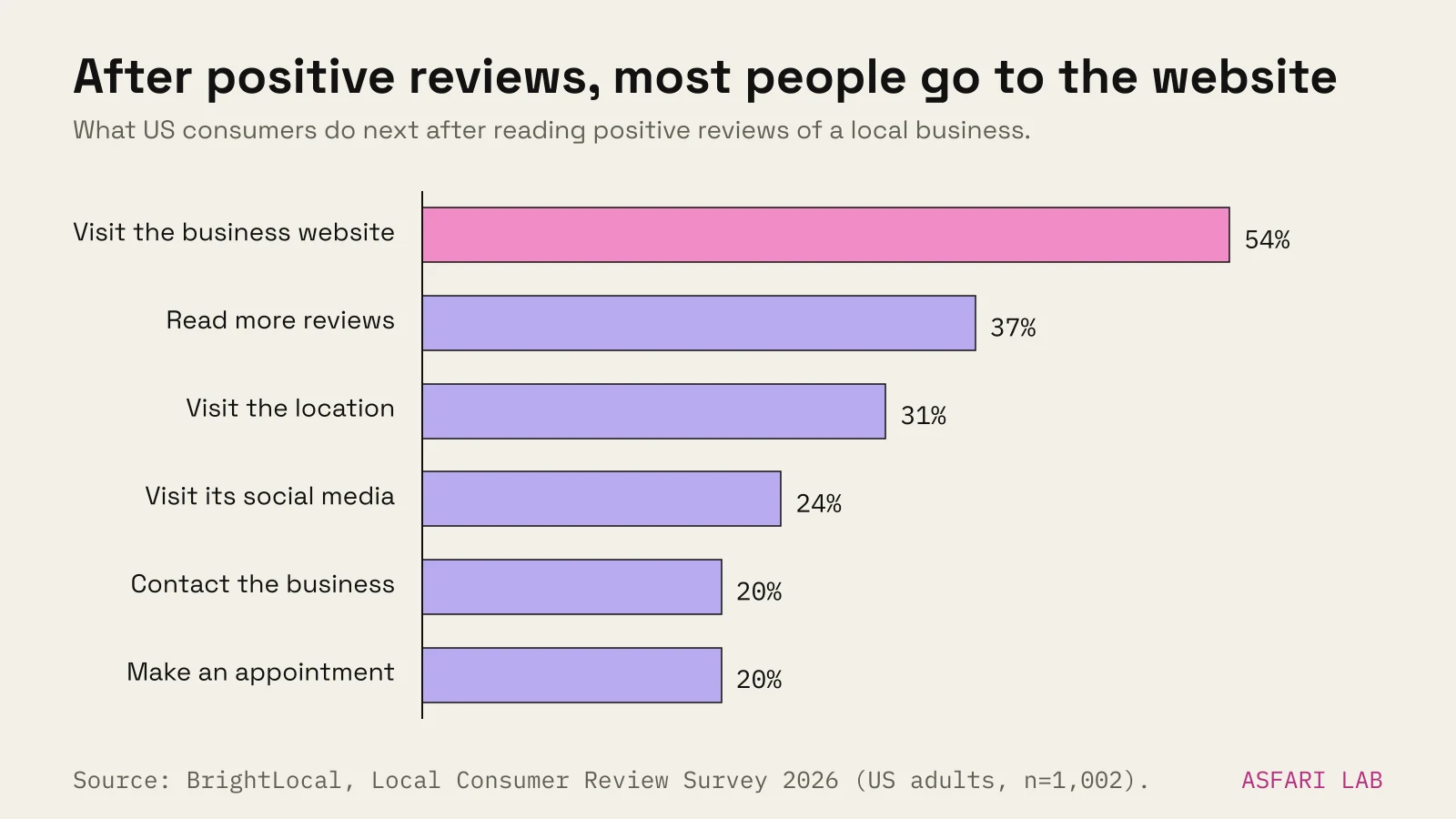
So more than twice as many people go to the website as to your social profiles. If you don't have one, that click goes somewhere else. Often to a competitor who does.
And many businesses don't. In BrightLocal's 2025 survey of 778 US small business owners, only 40% said they have a dedicated website. Facebook (50%) and Instagram (44%) were used more widely.
These are US figures. We haven't found an equivalent European survey, but the habit of checking a website before booking is not unique to America.
Can you use Instagram as a website?
Partly. Instagram now does more than it used to.
- Five links in your bio. Instagram has allowed up to five since 2023.
- Google can index posts. Since July 2025, public posts from professional accounts of adults can appear in search engines. It's on by default and can be switched off.
But it doesn't replace a website:
- No proper pages. There's no clean place for prices, menus, FAQs or terms.
- Search is weak. A post may get indexed. It won't rank for "hair salon Kalamaja" the way a page about exactly that can.
- Not everyone has the app. Some customers, from corporate buyers to visitors from abroad, may not want to log in to browse you.
- The feed buries things. Your opening hours are in a post from March.
Instagram is a great shop window. It's a poor reception desk.
The ownership risk
On Instagram you're a tenant. Meta's rules apply, and Meta's moderation decides.
In 2025, several news outlets reported Meta disabling business and personal accounts without clear reasons. Over 500 people contacted the BBC about lost accounts. A Dutch dress boutique lost an account with more than 5,000 followers.
A Canadian spray-tanning business owner told CTV News her client base was cut in half after her ten-year-old account was suspended. Appeals often failed. Paying for Meta Verified didn't guarantee a fix.
Australian small business advisers drew the same lesson. Their advice: build a website you control, grow an email list, and treat social media as one channel among several.
A website on your own domain can't be switched off by a moderation algorithm. Make sure the domain is registered to your business, not to whoever built the site.
Algorithm risk
Even when your account is safe, your reach isn't guaranteed.
What gets shown, to whom, changes when Meta changes it. You don't get notice. You can do everything right and see fewer people engage next month.
A website has its own rules, but they're more stable. If your page clearly answers what people search for, it tends to keep showing up.
The healthy mix:
- Instagram finds new people.
- Your website turns them into bookings and enquiries.
- Your email list or booking system keeps them, whatever any platform decides.
Google visibility and bookings
Many local customers start on Google, not on Instagram. They search, see the map, check reviews, and click. In BrightLocal's 2026 survey, 71% of consumers used Google to read reviews of local businesses.
Two things help you show up:
- A Google Business Profile. It's free. Service businesses can switch on online bookings from it, and restaurants can take reservations through partners.
- A website that the profile links to, with clear pages for what you do and where.
A profile without a website leaves gaps. Customers who want prices, menus, policies or a portfolio have nowhere to go.
For bookings, a website lets you choose the tool. You can take a deposit, set a cut-off time, add a question about allergies. On Instagram, a booking request is usually a DM you answer at 11pm.
Do I need a website for my small business?
Here's an honest checklist. You can probably wait if all of these are true:
- You're fully booked through word of mouth
- You don't want to grow, or can't take more work
- You never get asked "do you have a website?"
You need one if any of these are true:
- You want to be found by people who don't know your name
- You're running ads, or planning to
- You take bookings, orders or quote requests
- You sell to businesses, who will check you before they email
- Losing your Instagram tomorrow would hurt
What the smallest useful website looks like
You don't need twelve pages. A good small site can be one to five, which is what our website packages start with:
- Home: what you do, for whom, where, in one line, with one main button
- Services or menu, with prices or "from" prices
- About: who you are, why trust you
- Contact: address, map, hours, phone, form
- Booking or ordering, if you take them
Link it from your Instagram bio and your Google profile. Embed a few recent posts if you like, so the site stays fresh.
If a single page is enough, see Landing page or full website? For budgets, see How much does a small business website cost in Europe? If you're considering doing it yourself, read Is it worth paying someone to build a website?