
How long does SEO take? For a new website, it usually takes 4 to 12 months to bring steady traffic from searches that don't include your name. Technical fixes can show within weeks. Rankings for competitive terms often take a year or more.
That isn't us hedging. Google has said much the same. In its 2017 video on hiring an SEO, Google's Maile Ohye said SEOs typically need four months to a year to implement improvements and then see benefit.
Ahrefs' 2025 data adds a harder edge. The average page ranking #1 is about five years old.
So the honest answer depends on three things: how new your domain is, how competitive your searches are, and how much good content you publish.
What Google says about timing
Google doesn't publish a timeline for rankings. It does give clues across its documentation.
- Crawling a new page: "anywhere from a few days to a few weeks", per its recrawl guide.
- Indexing after a sitemap or request: allow at least a week before assuming a problem.
- Effect of changes: "Some changes might take effect in a few hours, others could take several months," says the SEO Starter Guide. It suggests waiting a few weeks before judging.
- Quality signals: Google's systems can take months to decide that a site consistently publishes helpful content.
Google is also clear that nobody can guarantee a #1 ranking. If someone promises one by a date, walk away.
How long does SEO take to see results? The data
Ahrefs has tracked this twice. Its latest study, published in 2025, followed millions of new pages for a year.
| Finding | Number |
|---|---|
| New pages reaching Google's top 10 within a year | 1.74% of a random sample; 6.11% of pages with real content |
| Of those that made it, share that got there within a month | about 41% |
| Top-10 pages older than three years | 72.9% |
| Average age of a #1 result | about 5 years |
Two lessons.
First, most new pages never reach page one. Publishing alone isn't enough.
Second, pages that do rank often move early. If a page is still outside the top 10 after about six months, Ahrefs suggests reworking it, because the odds drop sharply after that.
A realistic SEO timeline, month by month
This is our working estimate for a small business with a new site, one language and a local or niche market. It assumes steady work every month. It's built from Google's guidance, the Ahrefs data above and the order the work has to happen in. Your market may be faster or slower.
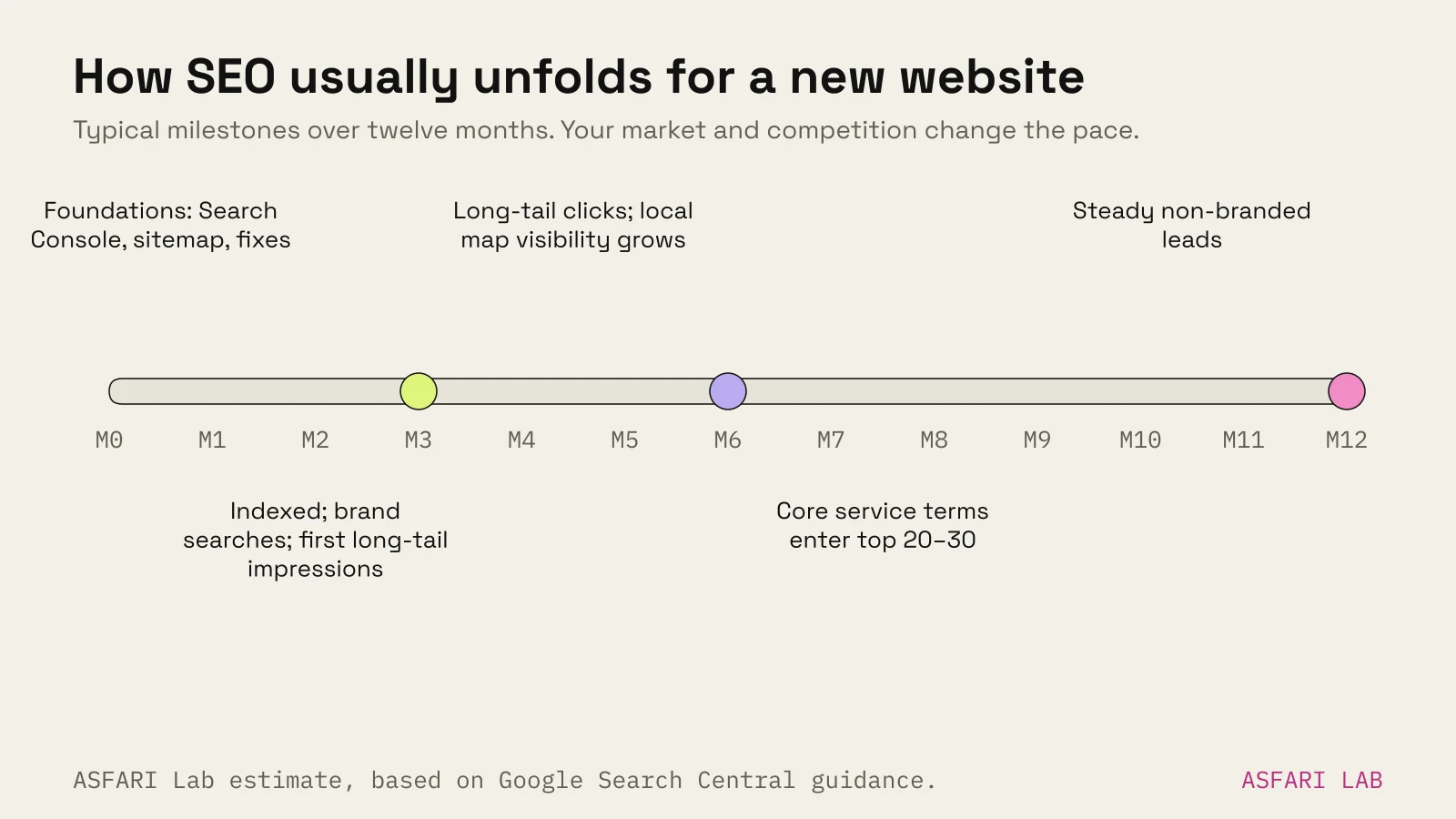
Month 0–1: foundations
Search Console set up, sitemap submitted, technical problems fixed. Pages get crawled and indexed.
What you'll see: your site appears when people search your business name. Not much else, and that's normal.
We did this on asfari.digital in October 2026. Domain property in Search Console, sitemap with 54 pages discovered, IndexNow for Bing and Yandex, JSON-LD schema. Mobile PageSpeed sits at 92–95 and the SEO score at 100. That's the starting line, not the finish.
Month 1–3: first impressions
Google starts testing your pages. Search Console shows impressions for long, specific searches. Clicks are few.
What to do: publish the pages that sell. One page per service, written in your customers' words. Get your Google Business Profile complete if you serve locally.
Month 3–6: the first real clicks
Long-tail searches start sending visitors. Think "wedding cake Tallinn price" rather than "cakes". Local businesses often see the map pack move first, helped by reviews.
This is when SEO usually "kicks in" for a small site. It's also when many owners give up, because the numbers still look small.
Month 6–9: harder terms move
Core service terms start appearing on pages two and three. Content that hasn't moved gets reworked. Links and mentions from other sites start to matter more.
Month 9–12 and beyond: compounding
Non-branded traffic and leads become steady. Each new page ranks faster because the site now has history and links. Ranking for the most competitive searches can still take years.
What speeds SEO up, and what slows it down
You can't force Google. You can stop slowing it down.
- Fix indexing first. A stray noindex tag or password costs months. See why your website isn't showing on Google.
- Target specific searches. A new site can rank for "accountant for freelancers in Tartu" far sooner than "accountant".
- Write for buyers. Service pages with prices, area served and proof convert the little traffic you get early.
- Link your own pages together. Google mainly finds pages through links. Make every important page reachable in a click or two.
- Earn real links. Suppliers, partners, local press, associations. Google's spam rules forbid buying them.
- Get reviews. For local searches they feed directly into prominence.
- Publish steadily. Two good pages a month beat twenty thin ones in a week.
- Keep the site fast. Speed won't rank a weak page, but a slow site loses the visitors you do win.
What slows it down
- A brand-new domain with no history or links.
- A highly competitive market, like national insurance or legal searches.
- A redesign that changed URLs without 301 redirects. You can lose rankings you already had.
- Thin or copied content, including mass-produced AI pages.
- Stopping and starting. SEO done for three months then dropped rarely pays back.
How to tell if it's working before the leads arrive
Sales are the last thing to move. Watch these earlier signals in Search Console's Performance report, month on month.
| Signal | Where to look | What good looks like |
|---|---|---|
| Pages indexed | Indexing → Pages | Every important page indexed within weeks |
| Impressions | Performance | Rising each month, even if clicks are flat |
| Queries | Performance → Queries | More searches that don't include your name |
| Average position | Performance | Key pages climbing from page 3 to page 2 |
| Clicks | Performance | Following impressions up, usually a few months later |
Compare like with like. Look at three-month periods, not single days. Seasonal businesses should compare with the same months last year.
If impressions haven't moved after three months of steady work, something is wrong. Check indexing, then check that your pages target searches people actually make.
Plan for AI search too
Search results now look different. AI summaries sit above many results and take clicks.
Pew Research found that when Google showed an AI summary, people clicked a normal result on 8% of visits. Without a summary, 15%. Only 1% clicked a link inside the summary.
That doesn't change the timeline. It changes what you aim for. Searches with buying or local intent still send visitors. Being the clearly-structured source an AI answer cites is a new goal alongside ranking.
SEO vs ads while you wait
If you need customers now, SEO alone is the wrong tool for the first few months. Paid search can bring clicks the day it goes live. Many small businesses run modest ads for months one to six, then shift budget as organic traffic grows.
We compare both in SEO vs Google Ads. For budgets, see how much SEO costs for a small business.
Our SEO & AI search programme is built around this timeline. Technical fixes usually show within weeks. Non-branded traffic and AI mentions usually move within three to six months, depending on your market and starting point.