
How much to spend on ads? Most guides say small businesses spend 2–10% of revenue on marketing. That range is real, but too wide to act on.
A better answer: work backwards from what a customer is worth to you. Then add a test budget big enough for the platform to learn.
For a small European business on Meta, we usually suggest a test of €300–€900 a month in media, plus the cost of making the ads. Here is how to get to your own number.
Method 1: a share of revenue
The simplest rule is a percentage of turnover. Published benchmarks:
| Source | What it says | Who it describes |
|---|---|---|
| U.S. Chamber of Commerce (2024) | 2–5% of revenue for B2B, 5–10% for B2C | Small businesses |
| Mailchimp | "Many small businesses" aim for 2–5% | Small businesses |
| Gartner CMO Spend Survey (2026) | 7.8% of company revenue, up from 7.7% in 2025 | Mostly firms over $1bn revenue |
Note what Gartner measures. It surveyed 401 marketing leaders, the vast majority at companies with over $1 billion in revenue. It is a useful ceiling, not a small-business target.
Also note these are marketing budgets. They cover everything: ads, website, content, design, tools, people. Ads are one slice.
Marketing budget for small business: an example
A shop selling furniture and decor online, turning over €300,000 a year:
| Line | Share | Per year | Per month |
|---|---|---|---|
| Total marketing (B2C, 6%) | 6% | €18,000 | €1,500 |
| Paid media (Meta, Google) | ~50% of that | €9,000 | €750 |
| Creative and campaign work | ~35% | €6,300 | €525 |
| Tools, email, website upkeep | ~15% | €2,700 | €225 |
The split is our illustration, not a benchmark. Your mix will shift with what already works. A shop with strong organic search can spend less on ads.
The weakness of this method: it ties spend to last year's sales, not to what ads can return. A new business with little revenue gets almost no budget, exactly when it needs reach most.
Method 2: work backwards from a target cost per sale
This is the method we use. It answers "how much to spend on ads" with your own numbers.
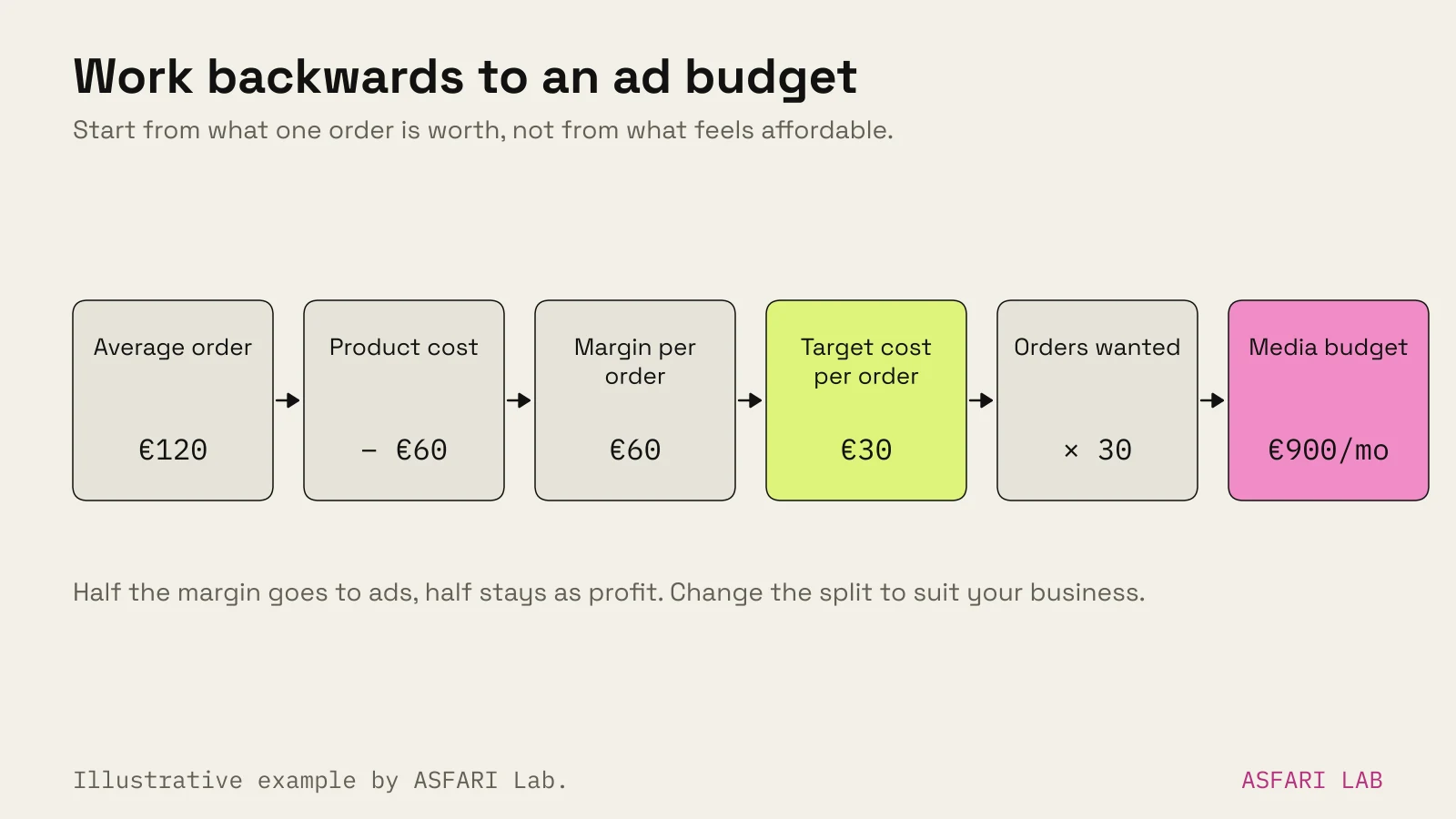
- Find your margin per order. Average order €120, gross margin 50%: you make €60 before marketing.
- Decide what you can pay to win an order. Say up to €30. That is your target cost per acquisition (CPA).
- Estimate conversion rates. If 2% of ad visitors buy, you need 50 clicks per sale.
- Check against click prices. At €0.50–€0.60 per click, 50 clicks cost €25–€30. The maths works, just.
- Set the volume. Want 30 extra orders a month? 30 × €30 = €900 a month in media.
The click price in step 4 comes from LocaliQ's 2026 benchmarks, where the all-industry Facebook traffic CPC was $0.60 (about €0.52). For Meta prices by country, see how much Facebook and Instagram ads cost.
If the maths does not work, don't buy more ads. Fix the offer, the price or the site first. Ads amplify a business that converts. They do not create one.
For lead-based businesses
Swap orders for leads. LocaliQ's 2026 Facebook data puts the average cost per lead at $27.39, about €24. If one in five leads becomes a client worth €1,000, a €24 lead costs you €120 per client. Most service firms would take that.
How much to spend on Meta ads to start
Meta needs data before it delivers well. Its learning phase looks for roughly 50 optimisation events within seven days of a significant edit, according to PPC Land's summary of Meta's guidance.
That sets a practical floor:
- Optimising for purchases at a €30 CPA? 50 purchases a week is €1,500 a week. Most small shops can't do that.
- So optimise for a more frequent event at first: add to cart, lead or landing page view. Then move up when volume allows.
Our working test budgets for Meta, in media only:
| Stage | Monthly media | Length | What you learn |
|---|---|---|---|
| First test | €300–€600 | 4–6 weeks | Which of 3–6 ads gets cheap clicks and engagement |
| Proving | €600–€1,500 | 6–8 weeks | Which offer sells, real cost per sale |
| Scaling | €1,500+ | Ongoing | How far the winner stretches before costs rise |
These are estimates from how the learning phase and Estonian CPMs work, not published benchmarks. If results stall, check why Facebook ads stop working before adding budget.
How much to spend on Google Ads
Google Search is priced differently. You pay for intent: someone typing what you sell. That usually costs more per click and converts better.
LocaliQ's 2026 search benchmarks (Google and Microsoft Ads, all industries) report:
- Average cost per click: $5.42, about €4.70
- Average conversion rate: 8.18%
- Average cost per lead: $66.69, about €58
These figures come from LocaliQ customers' campaigns and the report gives no country split. Clicks in smaller European markets are often cheaper, but we have no published Estonian figure to quote.
A rough rule we use: budget for at least 100–200 clicks a month per campaign, so you can tell good keywords from bad. If your clicks cost €2–€5 (an assumption; check Google's Keyword Planner for your terms), that is €200–€1,000 a month. For when search beats social, see SEO vs Google Ads.
Creative cost vs media cost
Many owners budget only for media, then run one ad made in an afternoon. That ad tires fast, its cost per result climbs, and the test "proves" ads don't work.
Plan both lines from the start:
| Media | Creative | |
|---|---|---|
| What it buys | Reach: impressions and clicks | The thing people see and act on |
| Who gets it | Meta, Google | You, a freelancer or a studio |
| Scales with | Audience size and goals | Number of placements and refresh rate |
| Typical risk | Spending into a weak ad | Too few versions to test |
When we built the Pisipuu campaign in the lab, for a kids' furniture brand, each placement got its own cut: YouTube 16:9, feed 4:5, story 9:16 and reel. The offer appeared by second three in every one. That is the work that makes media money go further, and it is what our Creative & campaigns service is built around.
How many versions do you need? Our rule of thumb sits in ad creative fatigue. Whether to hire for this in-house, with a freelancer or a studio is covered in marketing agency or freelancer.
How much to spend on ads: a simple way to decide
- Write down your margin per sale or per client.
- Set a target cost per result you can live with.
- Multiply by the volume you want. That is your media budget.
- Check it clears the platform's learning floor. If not, optimise for an earlier event.
- Add a creative budget for at least 3–6 distinct ads.
- Run for four to six weeks before judging.