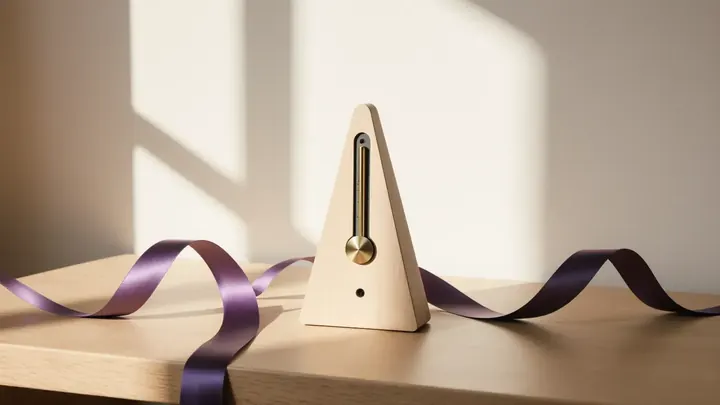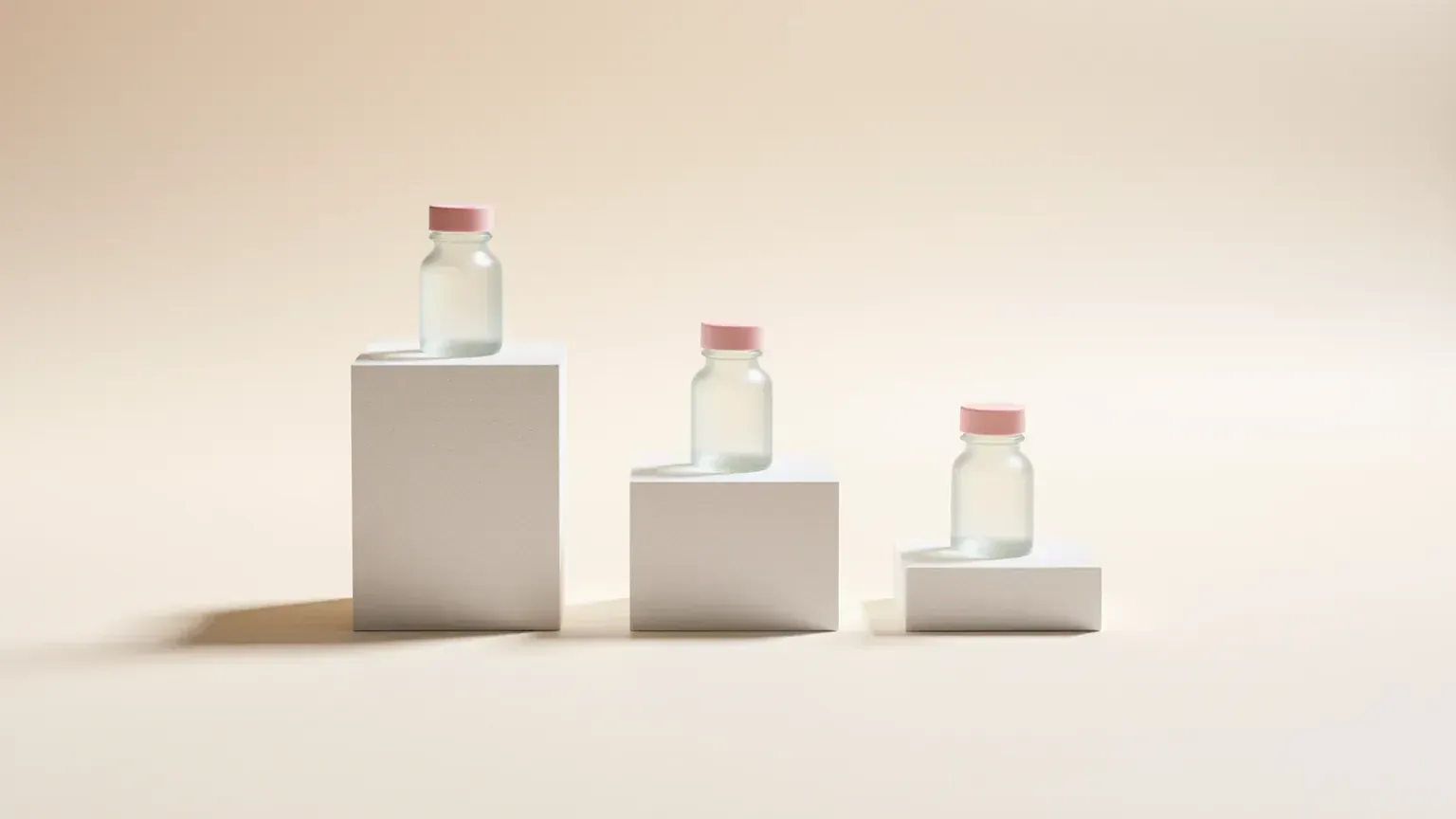
Product animation is a short film of your product made in 3D, not filmed. Most product animation examples fall into four types: a turntable, an exploded view, a liquid or material shot, and the product shown in context.
Costs swing widely. A simple turntable from an existing 3D model can be a few hundred euros on a freelance marketplace. A 30-second technical film with exploded views can pass €40,000 at a full studio.
Below: what each type is for, where it earns its keep, what AI tools can and can't do, and the 2026 price ranges. Our own examples are made in the lab: 3D loops of a perfume, a sneaker, a serum and headphones.
Why animate a product instead of filming it
Three reasons come up again and again.
- It doesn't exist yet. You can launch before the first production run.
- You can show what a camera can't. Inside the shoe, the layers of a serum, sound moving through headphones.
- One model, many outputs. Once the 3D model exists, every new angle, colour or format is a render, not a reshoot.
The trade-off is that animation looks like animation unless it's done well. Bad lighting and plastic materials give it away. For a deeper comparison, see 3D product animation vs photography.
Four types of product animation videos
1. The turntable
The product rotates slowly on a clean background. It's the simplest type and the most useful.
Best for: product pages, marketplaces, the first frame of an ad.
Our example: our headphones loop turns once and lands where it started, so it can play forever on a page without a visible cut.
2. The exploded view
The product separates into its parts, holds, then comes back together.
Best for: technical products, anything where the inside is the selling point, trade-show screens.
Our example: our exploded sneaker. Sole, midsole, upper and laces lift apart in a two-second move. It answers "what's it made of?" without a word, and it doubles as a strong visual hook for reels.
3. Liquid and material
Something pours, splashes, melts, ripples or catches light. The material is the subject.
Best for: beauty, fragrance, food and drink, anything sold on texture.
Our examples: our perfume hero and serum loops. Glass, liquid and light do the work. These shots are expensive to film for real; in 3D the splash lands the same way every time.
4. In context
The product in a real-looking setting: on a desk, in a kitchen, on a shelf in a shop.
Best for: ads, launch films and anywhere people need to picture owning it.
This type takes the most work, because the environment has to be convincing too. It's also where AI tools now help most, generating backgrounds around an accurate 3D product.
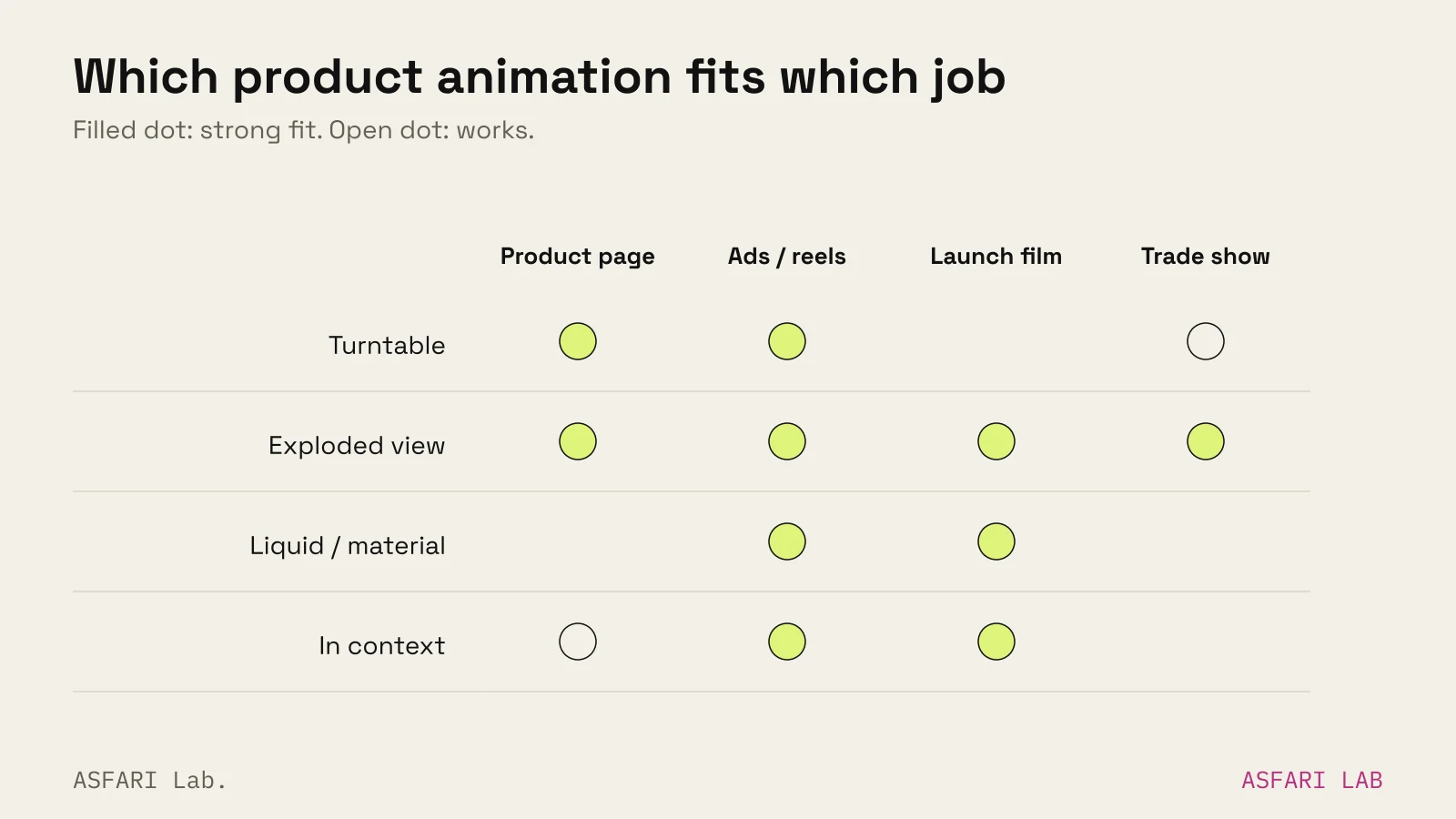
Where product animation earns its keep
| Where | What works | Length |
|---|---|---|
| Product page | Turntable or exploded loop, silent | 4–10 s, looping |
| Social ads and reels | Exploded or liquid shot as the hook, then the offer | 6–15 s |
| Launch | A short film that combines all four types | 30–90 s |
| Trade shows and retail screens | Exploded view on a loop, readable from across a hall | 10–30 s, looping |
| Presentations and sales decks | Turntable or exploded loop embedded in a slide | 5–10 s |
For product pages, keep the file light. A heavy video above the fold can slow a page down; see do animations slow down websites?. If you want shoppers to spin the product themselves, a 3D model viewer on Shopify is the interactive version of a turntable.
For ads, the animation is usually the hook, not the whole ad. Our reel structure puts a two-second product move first, then the proof and the offer. See how long a reel should be for the cut lengths.
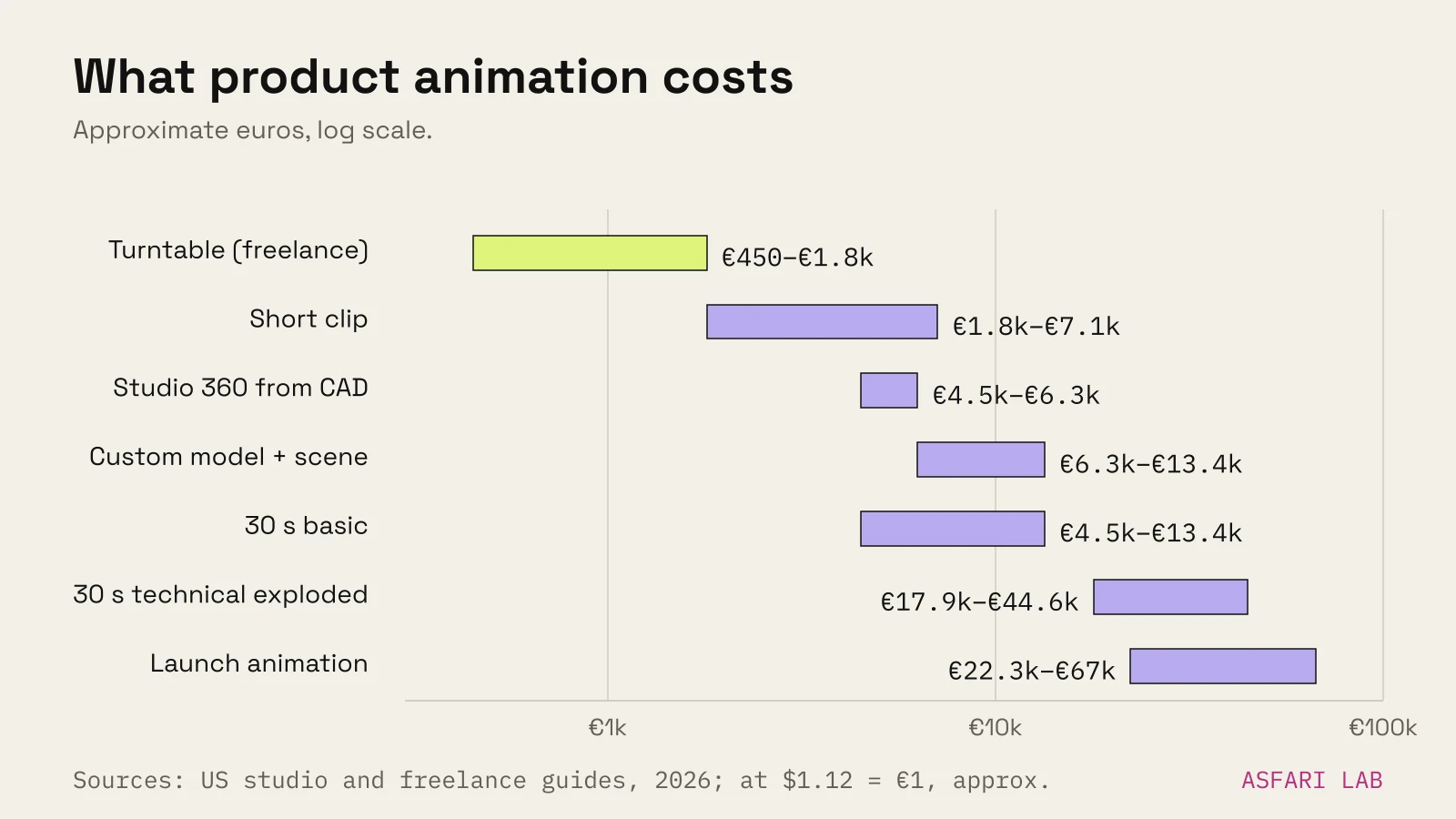
What product animation costs in 2026
Price guides vary a lot, because they price very different jobs. These are converted from US dollars at about $1.12 to the euro, so treat them as approximate.
| Type of job | Approx. € | Source |
|---|---|---|
| Turntable / 360 spin, freelance | €450–1,800 | Cad Crowd, 2026 |
| Short product animation clip | €1,800–7,100 | Cad Crowd, 2026 |
| Basic 360 rotation from CAD, studio | €4,500–6,300 | Vidico, 2026 |
| Custom model, materials and environment | €6,300–13,400 (2–4 weeks) | Vidico, 2026 |
| 30-second product animation, basic | €4,500–13,400 | Framesixty, 2026 |
| 30-second technical film with exploded views | €17,900–44,600+ | Framesixty, 2026 |
| Photoreal premium film | €13,400–44,600+ (4–8 weeks) | Vidico, 2026 |
| Product launch animation | €22,300–67,000+ | Framesixty, 2026 |
Why the same turntable can cost €500 or €5,000
- Does a 3D model exist? Clean CAD files save days. Framesixty flags messy CAD that needs rebuilding as a cost driver.
- How real does it need to look? A product-page spin on white is far simpler than photoreal glass and liquid.
- Who makes it? A freelancer on a marketplace, a small studio or a full agency. Framesixty also notes that labour rates in Eastern Europe sit well below US ones.
- How many outputs? Reusing one model across stills, loops and a film is the biggest saving available.
- How fast? Tight deadlines can roughly double the cost, per Framesixty.
For animation of every kind, per minute and per second, see animated video cost. For live-action comparisons, see what a video ad costs to produce.
What to send before you get a quote
You'll get a tighter price if you send: photos from every side, dimensions, CAD or existing 3D files if you have them, physical samples or material swatches, and a list of where the film will run. Say which formats you need up front, so the studio can plan the camera moves for 9:16 and 16:9 together.
Product animation AI and video makers
AI has changed the cheap end of this market. Image-to-video tools can now give a product photo some movement in minutes. Template-based product animation video makers let you drop a product shot into a pre-built scene.
What they're good at:
- quick motion tests before you commit to a full film
- backgrounds and environments around a product
- turning stills into motion when there's no budget for 3D. We do this in the lab, and wrote up the method in AI product video from an image.
Where they still struggle:
- Accuracy. Labels warp, logos melt, proportions drift between frames.
- Consistency. Getting the same product to look identical across ten shots is hard.
- Exploded views. AI doesn't know what's inside your product. A 3D model does.
Our Motion, 3D & AI films work is AI-assisted, human-led. A real 3D model keeps the product accurate; AI speeds up the scenes around it; people direct the idea, edit and sign off. If the ad runs in the EU, check the EU AI Act rules for AI-generated ads. For more on CGI in advertising, see CGI product ads.