A logo is one mark. A brand identity is the system around it: colours, fonts, imagery, voice and the rules that make every touchpoint look like the same business.
Most small businesses need more than a logo and less than a full corporate identity. If people will see your name on more than three things (a sign, a cup, a website, a post), you need at least a starter identity.
That is the short version of logo vs brand identity. The rest of this guide gives plain definitions and a decision guide by business stage, so you spend money on the part that matters now.
Plain definitions
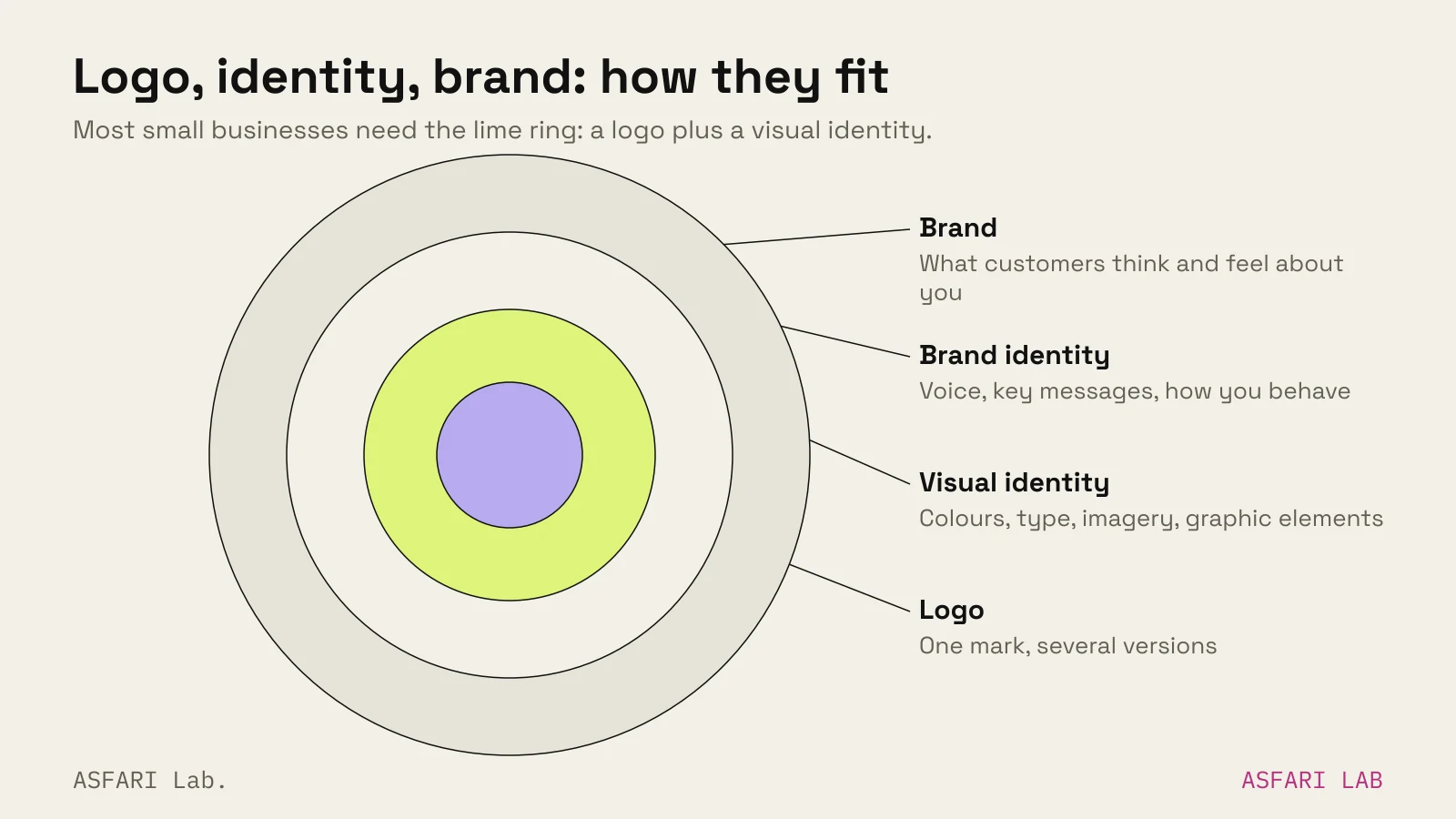
Logo. The mark that identifies your business. It can be a wordmark (your name in a specific lettering), a symbol, or both. It usually comes in a few versions: full, compact, icon.
Visual identity. Everything people see: the logo, plus colour palette, typography, graphic elements, photo or illustration style, and layout habits.
Brand identity. The visual identity plus how you sound and what you stand for: tone of voice, key messages, sometimes naming and positioning.
Brand. What people think and feel about you. You do not design this directly. You influence it with the product, the service and the identity, every day.
Our own service page puts it simply: a logo is a single mark; a brand identity is the wider system, covering colours, type, photo style, tone of voice and how these appear across website, packaging and social.
Logo vs visual identity: why the logo alone stops working
A logo on its own works on one thing at a time. Problems start when it meets the real world.
- Your Instagram avatar is a circle. Your horizontal logo becomes unreadable.
- The printer asks for the CMYK colour. Nobody knows it.
- A freelancer makes a flyer in a font you have never used.
- Your menu, your website and your bag use three different greens.
None of these is a logo problem. They are identity problems. A visual identity answers them once, so you do not answer them again with every supplier.
| Logo only | Visual / brand identity | |
|---|---|---|
| What you get | Mark in a few versions and file types | Logo suite + colours + type + imagery + guide |
| Who it helps | You, once | Every printer, freelancer and employee after you |
| Consistency | Depends on whoever uses it | Written down and repeatable |
| Approx. price (2026) | €580–€2,330 (freelancer to small studio, UK) | €1,750–€5,800 starter; more for full systems |
Price ranges come from Whito's UK benchmark (October 2026), converted from pounds at the ECB rate of 16 September 2026. The detail is in How much does a logo cost in 2026? and Brand identity cost: what a package should include.
Decision guide: what you need at each stage
Match your stage, not your ambition. You can always build up later if the foundations are right.
1. Testing an idea (first 0–6 months)
Need: a simple, clean wordmark. Maybe one colour and one font. Skip: guides, templates, packaging. Why: your offer may still change. Do not lock in a system for a business you have not proven yet. Do check the name is not already registered by someone in your field.
2. Opening for real (shop, café, studio, service)
Need: a starter identity. Logo suite, 3–6 colours with print and screen codes, two fonts, a social kit and a short guide. Why: this is when signage, cards, a website and social profiles all go live in the same few weeks. Getting them consistent at launch is cheaper than fixing them later.
3. Selling products or packaging
Need: a fuller visual identity. Packaging and label artwork, photography direction, graphic elements you can reuse across a range. Why: on a shelf or in a marketplace grid, the product is the brand. Each new product should look related without being redesigned.
4. Growing a team or locations
Need: a full brand identity with a proper guide and voice notes. Why: other people now speak for you. The guide replaces you as the person who says "no, not that green".
5. Something has changed
New audience, new offer, merger, or a logo that simply no longer fits. That is a refresh or a rebrand question. See Signs you need a rebrand, and what it costs.
Logo and brand identity design: how the process differs
A logo project is mostly drawing. An identity project is mostly deciding.
Logo project, typically 2–3 weeks at our studio: 1. A short conversation about the business 2. Two or three logo directions 3. Two feedback rounds on the chosen one 4. Files handed over
Identity project, typically 4–6 weeks: 1. The same conversation, with more on audience and tone 2. Two or three directions showing logo, colour and type together on real items 3. Two feedback rounds 4. Applications built out: cards, social templates, packaging basics 5. A mini guide written so others can use it
The second process costs more because each decision is tested on real objects before you approve it. That is where most identity problems are caught.
Kōhī: one idea, carried through
Kōhī is an identity we made in the lab for a coffee bar. It shows why a logo alone is not the whole job.
The logo idea is the macron, the short line over the long vowels in the name. On its own, that is a neat mark. It becomes an identity when the same line turns up as a detail on the cup, divides information on the business cards, sits on the takeaway bag and frames a social post. A palette and a type pairing hold the pieces together. A mini guide records the rules.
Without the system, a coffee bar with a good logo still ends up with a cup in one style, a menu in another and an Instagram grid in a third.
What to ask a designer before you choose
- "If I only buy the logo now, can it grow into a full identity later?"
- "Which colour codes and fonts will I receive?"
- "Do I get a guide, even a short one?"
- "Will you show the directions on real items, or on a blank page?"
If you go for the identity, a short guide is the piece that keeps it consistent. Here is what goes in one: What goes in a small business brand guide.
You can see what our package includes on the logo and brand identity service page.